Expansion Packs, Add-ons, Sequels, and Other Crap the World Doesn’t Need

I love the Sims. I am hopelessly addicted to the nutty little people that live in their own world on my computer. I am so hooked to this virtual crank that each time EA kicks out another goofy expansion pack for it, I bite and grab myself a few new locales or items for my little demented Sims to play with. The Sims is a completely genius game while at the same time, a totally evil one. It is a game that is groundbreaking in a multitude of ways, but for me, one specific trait stands out: The Sims franchise, for better or worse, made expansion packs and add-ons a norm of gaming. Sure, there were games before that did it and had success but no game boasts the breadth of expansion-y goodness that the Sims has on the market.

Enough of the Sims, I am here today to talk about expansion packs. Everyone these days has an expansion for something. →  The review for ‘Shark Sandwich’ was merely a two word review which simply read ‘Read Sandwich.’

Game genres and classifications

Recently I’ve been enjoying Gungrave Overdose, which you might remember as being reviewed as a solid little action game with a ridiculous 15 dollar retail price. With a solid combat system and great presentation, you could do a lot worse in the genre.

The question is, what genre am I talking about? The obvious answer is that this is an “action game”. But even though you shoot many enemies, this isn’t Gears of War or Rainbow Six. Gungrave is all about racking up multiple kills in a row with successive attacks, and using your limited arsenal to create combos. Playing it as a simple run-and-gun makes it a far more mindless experience than it actually is. So to be more specific, I would classify this as a “Devil May Cry”- like, something that most reviews agree with. But in my travels, I have even seen the game described in the same sentence as Tomb Raider.

What the hell? Tomb Raider is a platform-heavy adventure game. →  [link only works on even seconds]

On licensed games

Licensed games are probably the last thing an avid gamer would be worried about. Aside from the occasional gem, they are quite often the absolute bottom of the barrel in terms of quality. I still worry about them however, and there are plenty of reasons to do so. Let’s take a look at why.

The most important thing to understand about the modern licensed game is that it has changed greatly since the old days. Time was when video games were just another niche to exploit. They were never a primary source of profit, and so they never got a lot of money or attention. If they could whip up something playable and use marketing strength to sell enough copies, then that was good enough. Thus you had just about every movie or cartoon character finding their way into some sort of platformer or shooter. Swamp Thing, Total Recall, X-men, Aladdin. Robocop and Terminator. Robocop versus Terminator. Even food mascots got their game on. →  Sounds mildly entertaining, I guess.

Everything I know about RPGs I learned from Fallout

These days, the few western RPGs that exist that are not MMO’s are trying to conquer a unique challenge: How do you create a living, breathing world for the player to engage in? We’ve got the graphics, the items, and years of combat engines to take inspiration from. But we’ve played in static worlds before, where quests and NPC’s never change, and your options to mold the world are limited. We want games where the roles we play actually mean something, to ourselves and those we interact with.

It isn’t an easy task. You need the right size world, and the right contents in said world. You need smart NPC’s that go about their daily lives, and a ton of dialogue options to give players the illusion they are talking to a genuine person. Many games have experimented with these features, but I don’t think there are any that get them all down perfectly, or even close to perfectly. Oblivion, one of the poster children of fine Roleplaying, has characters who don’t open doors to enter buildings, and a handful of voiceactors each doing lines for dozens of townsfolk. →  Do the math.

How do you play a non-game?

Language is powerful, which is a shame since I’m not a very good writer. Instead of bringing “war” to Iraq we are bringing “freedom”, and instead of being “the worst American president in the last 300 years”, Bush has “a low approval rating”. Debating the merits of something specific may work for thoughtful people, but it’s much easier to simply change people’s minds by changing how we refer to things.

And so we have non-games. First, I must explain that I am not taking a stance on the quality of any game, non-game or partial-game. It’s a shame that this needs to be said but many people confuse the debate over language as a debate over what the language describes.

“I’m not sure the terrorists hate us because of our freedom.”
“What? You must want the terrorists to win then.”

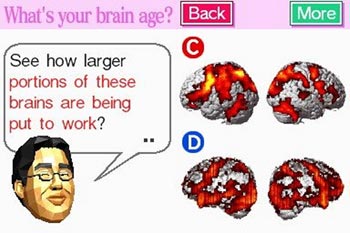
It’s actually a fact that humans don’t use 126% of their brain.

So Brain Training is boring, happy? Even so, the term “non-game” is generally used for anything somewhat different that people dislike. →  Theme Postital

Ruining A Beautiful and Complicated World: Simcity Societies and How It Will Take a Dump on a Perfectly Good Franchise

When I was twelve, my life changed. I was a chubby little kid who was obsessed with the Super Nintendo and for my birthday party my parents let me rent a few games to keep all of my little friends occupied and from ruining their house. One of the games I picked that day was something of a strange choice. Instead of running around killing things, you built a city and watched it grow. That’s it.

No mass multiplying mushrooms to eat, no princess to save, no Triforce to assemble. You simply sat down, plopped some buildings in, some roads to connect them, and then watched the whole thing grow. The game never really ended and you could devote hours to one city. When you got sick of the city, you brought down the wrath of God on it and many Sims died in a fiery…or watery death. Life was very, very good.

Over the years, the fine worker bees at Maxis churned out several revisions of the game that improved on the graphics and mechanics of game play. →  All your posts are belong to us.

What happened to competition? From arcades to gamerscores

Remember high scores. You don’t see them around very much, though they still pop up in some of my favorite new games. But why exactly did they begin to disappear? We generally hear explanations involving the rise of story based games and other such nonsense, but when three of the most popular games of the decade are Halo, Madden and World of Warcraft, it is tough to accept this as an era of Single Player. There must be another reason.

Before we look for that reason, we should start from the beginning and look at the nature of the high score. There were surely hacks and exploits available in some classic games (as any Street Fighter fan will know), but I would like to think they weren’t commonplace, and that more often than not the list of high scores in an arcade cabinet was the honest work of skilled players. It was a matter of pride to have your initials up there, and if you never got good enough to get there yourself, that was all the more reason to respect it. →  You think about everything.

What Call of Duty has taught me about the Wii

I’m just about willing to say that Call of Duty 3 is the most important game on the Wii right now. I couldn’t even finish it, yet it showed me a lot about the console that I never thought about before (or simply disregarded as false).

For instance, we’ve all heard the complaints from lazy gamers who are afraid of being active when playing the Wii, thinking they will get tired after only a few short minutes. Even before launch this was often mocked, and once people started playing, it seemed even sillier. But it isn’t silly at all. True, most games will not tire you out – even Wii Sports won’t unless you play it like a workout. In fact I’d say the Wii makes things much less tiring by allowing you to hold the controller in a variety of positions. But Call of Duty can tire you out.

Being a WW2 shooter, you are constantly at risk of being shot at, thus you must constantly be ready to aim. →  Final Fantasy Mystic Post

Fillet Mignon with a side of Pork Rinds: Awesome games and their stupid minigames

The average gamer supposedly plays 7.8 hours a week. That’s an ESA study so I think they rounded down to make gamers seem less crazy. Other studies show more like 20-30 hours a week, which makes more sense to me. For us hardcore gamers, I’m sure the number would be even higher.

So while we waste our life away playing video games, it has become painfully apparent to me that, like most products in our corner cutting capitalist society, video games have a lot of filler. A video game, especially an RPG or MMO, is graded on how much of your time it takes to beat. In most cases, a game with short playtime is over quickly and generally unsatisfying (much like sex with me). Longer games are considered better. One of the first questions people ask about a new RPG is “how long is it?” It’s an important benchmark.

Game developers often choose to provide filler, as opposed to costly and time consuming quality content. →  OutRun 2006: Post to Post

Top 3rd Party Wii Titles

It’s a fact that most people who own Nintendo consoles buy Nintendo-branded titles, like Zelda or Mario. This seemingly great position that Nintendo has put itself in is actually one of its biggest problems. Ever since the N64, 3rd parties have reduced the amount of games they release on Nintendo platforms. This then shifted the consumer populace to competing consoles like Playstation and Xbox.

Lately, Nintendo has become more attractive to many 3rd parties, with the DS and Wii becoming break-out hits. But that’s just the first step. The second one is getting consumers to actually purchase the 3rd party titles. If no one buys them, third parties will soon lose interest in Nintendo again. So to help reduce the likelihood of the N64/GameCube days from happening again, I have compiled a short list of the best 3rd party Wii titles that are now available.

Trauma Center: Second Opinion
Although this game is a “wii-port” of the now-great DS game, Second Opinion was definitely one of the best titles to hit the Wii at launch. →  And so it games…