Runegate – When Sales Beats Common Sense

Riot Games finally released a feature for League of Legends that has been begged for since the game’s inception: additional rune pages. For those of you who aren’t familiar, runes are one of the metagame features in League of Legends that allows you to customize your gameplay. You get a series of different slots, and can purchase runes that buff various attributes of your character: movespeed, damage, mana, health, etc. This enables additional strategy for the game, and runes can only be purchased via “Influence Points,” a currency that is only earned by playing the game (win or loss), as opposed to “Riot Points” which are only gained through real money transactions.

Up until yesterday, players only got two pre-set rune pages to choose from in a match. This is quite limiting, as many runes are only useful on certain archetypes: for example, mage oriented ability power runes vs. melee oriented armor penetration runes–and some runes are completely invalid on some characters: mana runes on a mana-less character, for example. →  Contains 10% more consonants than comparable articles.

Review – League of Legends: Season One

Following many months of “live,” but not “ranked” gameplay, League of Legends, published by Riot Games, has gone pro, launching their competitive Season One. Featuring several ranked ladder modes: “solo” (actually solo or duo play) 5v5, full premade 5v5 and full premade 3v3, the ladders will culminate with tournament play and $100,000 of cash and prizes. Although Riot will not release simultaneous usage numbers, they have confirmed through various online sources they have over 3 million registered accounts. With the DOTA community estimated at 7-9 million players built over a decade, Riot should be proud of how quickly their game has caught on and distinguished itself in broad field of incumbents and competitors.

Unsurprisingly, Season One is mostly more of the same. On the cosmetic side, both the website and the game’s launcher UI received new snazzy themes and sound track. For the game itself, beyond the usual patch changes of balance tweaks and a new hero, a draft mode was implemented for competitive play. →  One must imagine video games happy.

Nuggets of Wisdom – Slime that Designer!

As a gamer, I’m often puzzled by decisions game designers make. This most often occurs with MMOs, where the eternal question of “poor decision or lack of resources?” seems to apply, but many console games come to mind, like the Gears of War magic chainsaw. Of course, as a gaming consumer, I am simply the target of disdain, condescension, and of course greed of the gaming industry. I sat pondering my frustration with the lack of two-way communication about design decisions in an era where second guessing the experts is the norm: we can go on WebMD and diagnose ourselves, yet I can’t get a straight answer out of a game designer. I’ve often wondered what it’d be like to sit down with a game designer and get the real scoop on why they did something in their game that makes absolutely no sense.

And then it hit me. The answer is, of course, a game show. The concept is simple: envision a game show, likely on Spike, where famous game designers are put on the stand. →  Read Danger!

Review – Children of the Nile / Alexandria

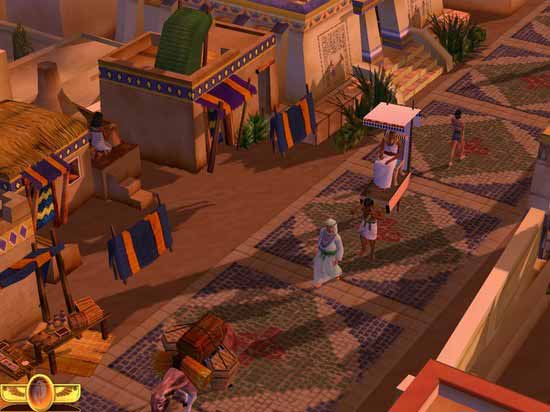
Children of the Nile is a continuation, and possibly the final installment of the fairly successful Pharaoh series, taking advantage of the excellent setting of ancient Egypt as a basis for a robust city builder. The people of ancient Egypt are civilized enough to be needy bastards– a prerequisite for any builder, and in an era filled with war and great deeds, we’re off to the races of conquest and glory.

COTN’s greatest strength, without a doubt, is the ecosystem of its city. Your people have multiple “tiers” of social standing, with each level having its own behavior and needs. Your job, of course, is to keep those needs satisfied so their efforts can be directed towards doing useful things for you: killing your enemies and building great works in your name.

There are two backbones of the COTN experience: food, which serves as universal currency in a barter system, and the satisfaction of needs. Food is harvested by farmers, of course, and then wends its way through a variety of nobles (through taxes) and shopkeeps (for purchase of common and luxury goods, keys to happiness for your people). →  Silent Post 2

Building a Mystery… I mean a City Builder

Growing up, I was a huge fan of Legos. Loved the damn things–I think I spent time after grade school every day building Legos and watching old Batman reruns (POW!). Now that I’m an adult, it’s not really appropriate for me to build Legos, but it is OK for me to play video games. This is probably why I gravitate towards city building games: I like the act of creation, and seeing the fruits of my labor, even if not a damn street in the city goes in a straight line because I am a creature of impulse.

While recently lamenting the lack of new city builders (triggered by playing Roller Coaster Tycoon 3 and associated expansions yet again), I decided to dig around for some of the “golden oldie” city builders. Immediately what came to mind were Tropico and Pharaoh, two very different, but very entertaining city builders. Imagine my shock when I found that both had additional installments in their series. →  Read it your way.

Review – Eve Online Dominion

Being primarily an MMO gamer for the past decade, I am continually amazed at my ability to be angry when developers release an untested pile of crap and demand you pay for it–which of course a gamer will. However, much as an old faithful geyser, my naiveté and then resulting hatred spring eternal. The latest source of my ire is none other than my mistress Eve’s latest expansion: Dominion.

Eve has continued to capture my attention for a variety of reasons. It remains an incomparable sandbox of player driven activity, a unique novelty amongst the “theme park” style that dominates MMOs today. The fact that it is a single server, one giant, interrelated universe also adds to its charm. And finally, the fact that their expansion packs, as a result of the other two reasons, are always free works to developer’s CCP’s favor.

Each expansion has focused primarily on a particular game element in gory detail. The latest expansion, Dominion, is targeted upon evolving what is known as “0.0” space, a lawless area where players can build their own empires and fight wars at an epic scale. →  Think outside the post.

Review – League of Legends

League of Legends, the stand alone Defense Of The Ancients clone released by Riot Games, bills itself as better than DOTA. The good news: it lives up to its billing. Without a doubt, LoL is a superior product to DOTA. This should not be surprising. Being able to draw from established source material, recruit one of the recent caretakers of the map (Pendragon) and build a real, non-volunteer design team, made the first part of Riot Games’ job easy. But credit should be given where credit is due: these ingredients do not automatically make a good game, but Riot has ensured that they have taken the best of DOTA and added much more.

As one would expect, there is much to love about LoL. The evolution of the DOTA concept can be extended to two distinct aspects: the community interface, and the game itself. The community interface is something sorely needed, as any moron can tell you. Because the internet is full of morons, it becomes the task of the developer to reward good behavior and punish bad to attempt to make the online experience as pleasant as possible. →  Eh, I’ve got nothing better to do.

Leveling up the Experience System

Over the past twenty-five years of the “modern” RPG era in gaming, we’ve seen the genre advance tremendously. Rendered graphics, advanced skill systems, voice acting and ever more colors of chocobos are in the vanguard of innovation. But one thing we have not seen advance in any particularly cogent fashion is the experience system.

On the surface, the experience system is relatively straight forward. You kill monsters, you get stronger. This can take a variety of formats: from the basic experience system that leads to levels which grant automatic stat and ability increases, to systems where experience or a similar credit system are spent on customizable skills, to hybrid systems which do both. Gaining levels serves to complement the plot at a tactical level: as the story progresses, inevitably the farmer-turned-hero, imaginary-underwater-volleyball-player-turned-hero, or emo-sixteen-year-old-turned-hero will grow more powerful from a plot context. Therefore it is only logical your options go from basic attacks to complex spells, special moves, or the ability to dual wield double dildos. →  I only ask one thing. Don’t read in my way.

Are you Smarter than 100 other Xbox Live douchebags?

Reading even a few game sites is guaranteed to expose you to a certain amount of PR jizz: with machines like Microsoft, EA, Activision and others, it is inevitable you will be exposed to their products through the usual gaming channels. So it was with 1 vs 100 for me. By way of Penny Arcade, I was subjected to a face full of “OMG this game is awesome” jizz. But it was free, so I figured I’d check it out.

For those of you who have been held hostage in a shed for 18 years and were only recently freed, 1v100 is a gameshow that originated in the Netherlands and was hosted by Bob Sagat in the US. 1v100 pits the “one” against the “mob” in a series of trivia questions. The goal is for the “one” to outlast the “mob.” If a member of the mob gets a question wrong, he or she is out. As more mob members fail out, the cumulative prize pool increases. →  What can change the nature of a post?

Golden Jew’s Nuggets of Wisdom #5

My initial thoughts of the DS, complete with its Nintendo Gimmick Stylus, was that it was a Junior Pokemon Power Ranger Machine (my affectionate nickname for the Wii that drives Jay up the wall). I had no desire to draw rainbows (for fear of pissing off these people) or successfully masturbate a virtual cat into ejaculation with a stylus, so the DS didn’t seem right for me. Of course, with a $200-ish pricetag and no games I like I didn’t seem like a PSP person either. I thought that my next generation future was the same as my high school prom future: bathroom abortion baby. Or more accurately, being date-less.

Then I started finding good RPG games on the DS. Etrian Odyssey (1 and 2), Chrono Trigger, Magical Starsign, Final Fantasy Tactics A2, Dragon Quest 4 (it gets a grudging “good” vote) and now Devil Survivor have all sucked me in. I had the desire to play nearly all of those games in my home, as opposed to on the go, which is the highest compliment a DS game can get from me–being the best available option in my house full of video game toys. →  Read Theft Auto 4