Review – Final Fantasy Crystal Chronicles My Life as a King of the Jews

Final Fantasy Crystal Chronicles: My Life as a King is a simulation game. When I first saw the name, I thought it would be another delightfully (?) simple RPG. Instead, here we have a delightfully simple sim; in fact, MLAK is hands-off nearly to the point of annoyance.

In MLAK, you build your city structure by structure and converse with your citizens (when they are willing to talk to you, that is). That is just about it. The city is composed of empty green glowing spaces that mark where you can place buildings when you have the resources needed for their construction. These buildings range from houses to various shops for your citizens and adventurers. You commission these adventurers to explore the surrounding wilderness to get more resources and advance the plot, and occasionally they will actually do so.

This should feel familiar to anyone who played Microprose’s old PC RTS Majesty. You hire some heroes, give them some nice shops, and then they would immediately run off and die, start stealing from your kingdom, or hide from the scary trolls in their rooms. →  Postgaea 2: Cursed Memories

Review – Call of Duty 2: Big Red One

I have a confession to make. Despite my general crankiness about the game industry, as well as my increasingly picky taste, I have a soft spot for a bane of the industry: World War 2 shooters. Chalk it up to the fact I am a history buff with a desire to compare in-game depictions of certain battles and weaponry to reality. This weakness has led me to play some of the worst Medal of Honor games, as well as to attempt to beat Call of Duty 3 on two different platforms (I finished neither). Finally the genre has provided a diamond in the rough.

When Call of Duty 2 was released on 360 and PC, someone decided to give gamers still using “old gen” consoles a consolation prize. A “bitch game” if you will. This came in the form of Call of Duty 2: Big Red One. Big Red One had nothing to do with the real COD2. Upon first impression, Big Red One looks like shit; something that developer Treyarch had dumped on the PS2 in order to squeeze some more money out of the franchise during the holiday rush of 2005. →  Look upon my works, ye mighty, and read!

Review – Civilization Revolution Demo

As the name might imply, it’s hard to make a full judgment of Civilization Revolution based on the demo for a few reasons. The game is time limited, you can only play on “pussy” or “Jay” mode (we’ll let the readers decide which is worse), both giving you bonuses significant enough that it’s hard to get a flavor for real balance. The Civlopedia isn’t full, so you can’t analyze all the techs without playing countless times, and you are limited to two civilizations. Despite these limitations, what you can do is get a good feeling for how Firaxis dramatically changed the game-style of Civ while still keeping it Civ–a paraphrased sentence you’ve heard over and over again about the game which is an excellent way to open up this review.

This is unrealistic. If Ghengis Khan had a problem with you he would simply eat your family in front of you, fueled by the sound of your wailing and sobbing.

Leading off the list of changes is the fact the game has done away with workers – those little happy slaves who built the empire of Civilizations past have fled for greener pastures (they hired coyotes to take them to a more liberated game). →  Final Post VII

Review – Sam & Max: Night of the Raving Dead

I’ll be honest with you. When I started writing this review, I was only doing it to get this game out of the way. I really wanted to review episodes 4 and 5, and it just didn’t seem right to skip this tale of the emo undead, no matter how mediocre I may have found it upon first playthrough. As I began writing, however, I realized that this game taught me something. It taught me why I play Sam and Max. Not a deep, meaningful life lesson by any means, but a lesson nonetheless.

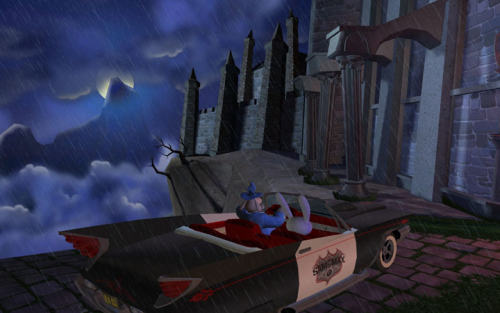
To catch people up who haven’t played the game already, New York is invaded by hoards of zombies, and Sam and Max must travel to Stuttgart in order to stop them at their source: a castle-turned-goth-club called “The Zombie Factory.”

“I will go this far and no further.”

As a number of reviews have pointed out, this game should have been brilliant. The designers are growing accustomed to the new hint system and introducing more complex, interesting puzzles without fear of alienating players. →  U R Not lamE.

Review – LostWinds

As I searched for the final area of LostWinds my entire family died in a flaming plane crash. I mean the game crashed as I was going from one area to another. The controller stopped responding and I was once again forced into physical activity by the Wii. I made my way to the system and shut it off, annoyed that I had stumbled upon one of the LostWinds glitches I’d read about but still psyched because I knew I’d finish the game in the next half hour. So I rebooted the console and loaded up the game again. All the save files were gone. Crashing and being turned off during the hang up removed all the progress I had made. It’s safe to assume I am reviewing a game I did not finish.

Technical issues aside, will this game’s voice be heard or will it break like the wind?

Knocking people around with wind is a nice way to spend time after you’re done with the adventure.

 →  Lords of the Read 2

A survey of 2007s role playing games

Last year was a fairly interesting one for RPG fans. Some of the biggest names in the genre finished their PS2 swan songs long ago, and went off in search of new platforms. This left 2007 as a year for new ideas and lesser known series to take root and grab the hearts and money of fans. 2007 may not have had a big new Final Fantasy, but perhaps that is a good thing, as it allowed these other games to stand out, rough edges and all. While it comes a bit late, the following is an assessment of some of 2007’s biggest RPGs from both Chris (vl’s resident RPG expert) and Christian (who continues to look for the genre’s masterpiece). We also included FF12 in the mix. It may be a bit old to us modern folk living in 2008, but it is such a major departure from Square’s usual offerings that it deserves a bit more discussion on the site. →  Onimusha 2: Samuread’s Destiny

Review – Shiren the Wanderer

Shiren the Wanderer is the video game equivalent of Candide. Think of something that can go wrong and it will, but not in the normal “I locked my keys in my car” kind of way. Like its literary inspiration, things don’t just not work out, they go absurdly wrong. As in “I locked my tiger in my car but forgot to unstrap my newborn child from the baby seat” wrong.

Shiren meets so many untimely deaths so often that it seems the game is mocking you. The most ridiculous deaths at least allow you to join in the laughter. For example, on the last level of the game a minotaur picked me up and threw me into a corner, then proceeded to pick up and hurl another minotaur at my head, followed by an undead mage, followed by the final boss itself. Had the mage not already sealed my ability to use items I may have stood a chance, but in the state I was in all I could do was wait for each of these enemies to take turns pummeling me. →  Just read it.

Review – Opoona

If a game contains art, is the game itself art? Is it moral for the local populace to manipulate an alien child into doing their bidding? What in the hell does that old engineer want with a sand weasel? These questions and more are asked in Koei’s latest published game, Opoona.

Reviews have not been altogether friendly to Opoona. I am here to tell you that yes, it may well be a horrible game. It has an occasionally annoying camera, a bad translation, and it’s easy to get lost even in the first dome-city. I am also here to tell you that I still really enjoyed Opoona despite these flaws.

But is it art?

I’ll get the bad parts out of the way first. First off: No voice acting. Sorry. I didn’t care; hell, I didn’t even notice until I realized the whole game sounds very uniform and ambient. Nothing breaks it up. Some people think this is a negative. I’m just glad they didn’t give Opoona and his siblings horrible squeaky voices. →  Now with fewer vowels.

Review – Yakuza

As a fan of the Shenmue series I was induced to try Sega’s Yakuza (non-neutered Japanese name: Ryu go Gotaku, or Like a Dragon). Hardly a review was written that avoided comparing some aspect of the game or the game itself to Sega’s acclaimed series. If you have not already played them, I am here to tell you that these are drastically different games. While there are some cosmetic similarities, the crowd that adores Shenmue (at least those who do so for the same reasons I do) will not find a spiritual successor here. While both games are basically brawlers in an open world, with plenty of side quests and dark corners to explore, the heart of Ryo is absent from the muscular Kazuma.

Shenmue has many strengths (and several weakness), but chief among them is Ryo’s hesitance to resort to violence unnecessarily and his ineptness in many adult situations. The obvious example is his incompetence in wooing the lovely Nozomi (and several other females that throw themselves at him), but there are subtler examples, such as the way he prosecutes the early stages of the revenge he seeks for his father’s murder. →  I’d rather die than not read this article!

Review – Fire Emblem: Radiant Dawn

Sequels suck. Prequels putrefy. And spin-offs spin out of control. And yet, so often when a story we enjoy ends, whether in the terra-forming of Arrakis or bodily ascension to heaven, we are reluctant to let go. We refuse to accept that resurrecting something so that it can go on eternally is usually a bad idea (I’m looking at you evangelicals.) The exceptions, (and there are a few: Godfather II, Red Dragon, The Simpsons, The Bible Goes West) prove the rule. So, when one of these quality exceptions of a continuing storyline comes onto the scene, especially in our medium, I think it’s time to take a holiday from derision and give the credit where it’s due. Such is the case with Fire Emblem: Radiant Dawn. So, sit back and let me tell you about the shining dawn of a radiant path in brilliant storytelling and those who have strayed from the light.

Blah blah blah.

Gamespot gave Radiant Dawn a 6.0, calling the plot of the game “terrible,” and the IGN reviewer, despite having given the game an overall score of 8.0, complained about the “extremely simple storytelling that makes use of only a backdrop and some character art.” →  Readbot Chronicles