

In my post about the MSX2 version of Golvellius I briefly mention that I gave the PC88 version of Miracle Warriors a few minutes of attention before befuddledly giving up. Well, I went back to correct this oversight… and didn’t get much farther in terms of actual progress, though I did spend hours trying. The initial hurdle is getting the game to actually load. The first time I booted it up and read the EGG Console directions the publisher was kind enough to include, I correctly booted the software, created a loading disc, changed to it, changed back to the program disc, and started the game.
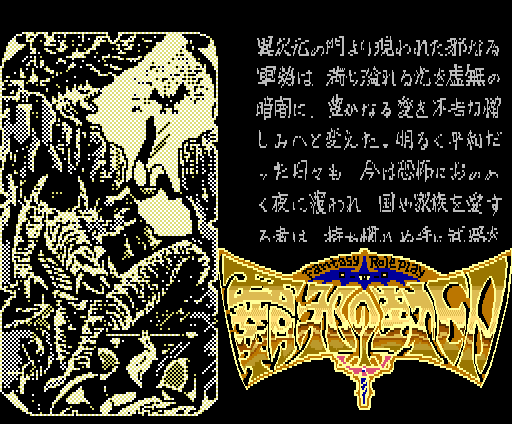
Coming back to Haja No Fuuin weeks later, the process mystified me. What I thought I did the first time no longer worked and I spent half an hour messing around with disc swapping and loading. Luckily, the all-katakana directions and error messages were beyond the Google phone app’s ability to translate. Unluckily, I have a few friends so I sent a pic to site admin Chris and he gave me assistance with the Japanese. I apparently had to swap discs while the intro plot scroll was happening despite not actually being told this anywhere in text. So did Chris actually contribute? I am too polite and magnanimous to say.
Here is a belated description of what this game is, at least in its Master System incarnation: Miracle Warriors is a port of an old Japanese PC game (Haja No Fuuin, which is what this post is actually about) that was actually the first JRPG to make it to North America on any console. I go into detail on the game in this ancient post. People who played it when it came out often have a mild fondness for Miracle Warriors but it is generally derided by those who attempt to play the game in this modern era of silicon chips and space age polymers.
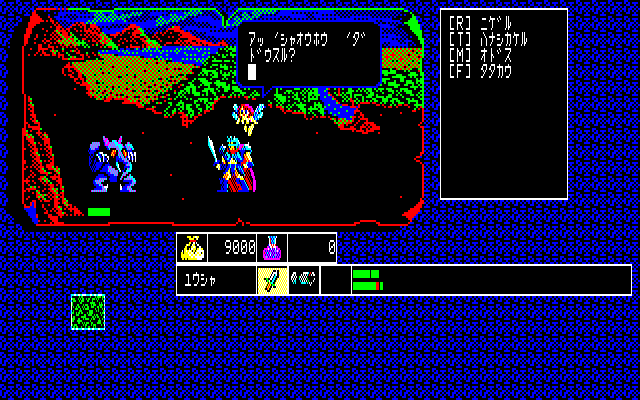
Back to a direct comparison of Haja No Fuuin to Miracle Warriors. The first and perhaps gravest sin (disturbing the life cycle of nature) is the game’s complete lack of any sound, most notably music. It casts a pall over the whole experience. It’s never been something I’d thought about until now when faced with this silence – even inscrutable games have some semblance of the developer saying they are there with you, keeping you company by the mere fact that some part of the game is just automatically happening. Haja No Fuuin being in Japanese (and possibly incomprehensible to those who speak Japanese) and the absolute vacuum of sound the game takes place in makes the player feel isolated and entirely on their own.
The visual presentation is overall a step down from Sega’s console version, and it looks like what I assume an old computer game would look like. There are, however, a few new graphical things like a rolling scroll (as in parchment) effect shown to change the scene when you enter a castle. The fairy that persistently follows you around also seems to speak in this version – it is entirely speechless the whole of the Master System version if my memory is reliable.

Some sites erroneously say you can only ever see the square you are standing on while others roneously say that the view of the overworld map can be expanded. Still, seeing only the exact tile you are on for however much of the game until you upgrade your view is really frustrating. As you may be able to guess, I did not personally expand the view of the map but I have seen screenshots that, if not photoshopped in an elaborate ruse to fool people doing research on a 40 year old Japan only computer game, show a view of 5 by 5 tiles and not just the one you’re currently standing on. Another navigation difference – in Miracle Warriors, water tiles just stop your progress but in the original version you can actually walk into them. They damage your party and then you wash ashore on some parcel of land. Of course, you don’t know where you wash up because you only see the single tile you’re standing on so reorienting yourself is nigh impossible.
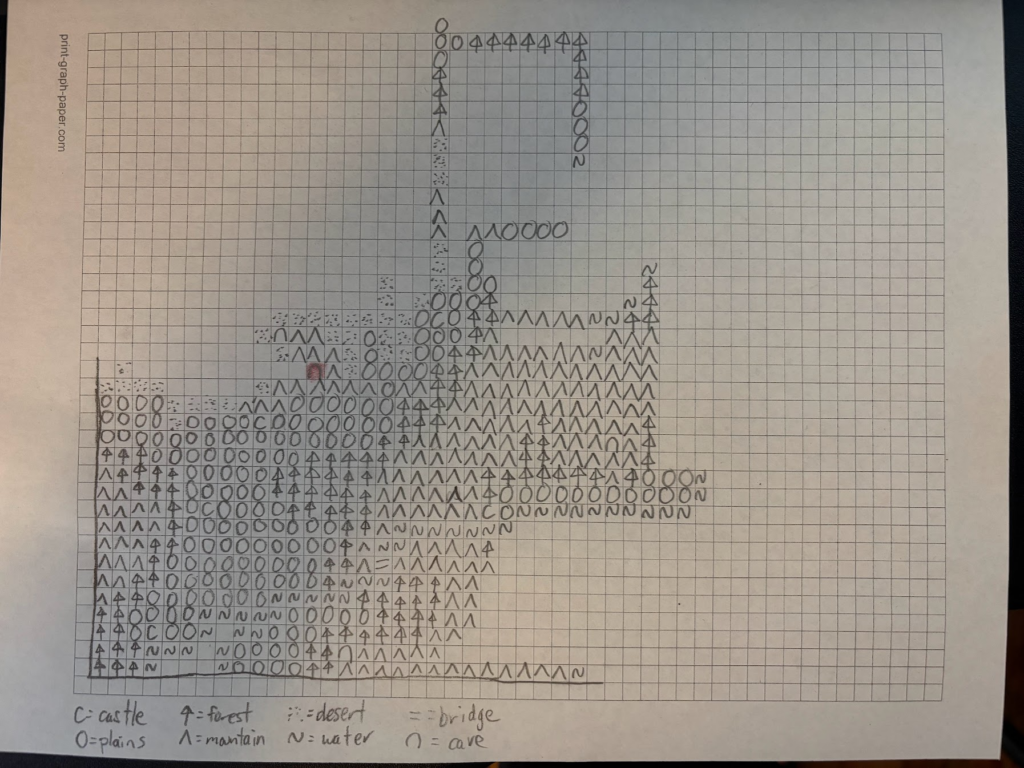
Some time with Haja No Fuuin reminded me of an eternal truth – making a map is fun. I may be too lazy to actually map out dungeons in games 99% of the time, but this old RPG absolutely requires it (though admittedly less so after I realized there is a map that comes with the games extra materials). I think that I ultimately enjoy games that make you write things out to get through them. If I can bash my head against obstacles a bit and get past a dungeon without taking notes, then I won’t, thereby depriving myself. It’s important to design these things to be mandatory if that’s what your design is aiming for.

I was cruising through the game, about as well as a whale can cruise through a jungle, making real progress while referencing the materials on how to play that EGG gave me with my purchase when I realized that there are large chunks of the game that are not referenced in these materials. This means that going to towns and trying to shop or heal is all untranslated and not referenced in the manual. Oddly enough, it’s sort of worse to sell the game with half the necessary translated material than to just offer it entirely untranslated and without any guides in English. Maybe. Maybe not, I’m not a scientist.
Besides the dearth of music, the control input is severely fucked up for a game being played on a console. Fuuin has you scrolling through the alphabet looking for specific letters or numbers to enter that correspond to some command – which makes sense considering a keyboard was the original form of input. And yet, it’s tedious in a game that would be tedious without this extra layer of tedium.

While I found the MSX2 Golvellius to be inferior to the Sega reprogrammed Master System port, it was at least fully playable – I played until the game was over. You could say my knowledge of the Sega game gave me a head start, but I know the Sega port of Miracle Warriors well and yet Haja No Fuuin is completely insurmountable. Or so I thought when I began writing this paragraph a few days ago. In the elapsed time, I managed to make some more progress, as well as did some other stuff like eating and sleeping. The game is still inaccessible to anyone who cannot read Japanese, but there is something to the madness. Perhaps it’s just the same stupid difficulty and mapping of slow progress while discovering new things that also makes Miracle Warriors oddly compelling to me, but I almost had fun with Haja No Fuuin.
Two things completely killed my progress, and they’re both possibly tied to my inability to read the game and the Google apps inability to translate about 70% of it on the fly. First, I hit a puzzle that required keyboard entry of a spell. I can only assume it would be something written in Japanese (the keyboard interface allows both Latin and Japanese font input) and the idea of actually parsing through what everyone says in order to learn and then transmit this information is daunting to someone who doesn’t know the language. I have learned and forgotten hiragana twice, though, so I am on my way.

The other hurdle I encountered was tied to the always unpopular mechanic of weapon durability. Simply walking around the areas with monsters I could defeat led to a slow dwindling of my resources. I could not make enough money to keep my character healed and my weapons functional. My guess is if I read Japanese, there would be some ways to mitigate this – perhaps the herbs I couldn’t figure out how to buy are cheaper than the doctor in town, or perhaps the item I picked up I didn’t know how to use was a magic spell I could deploy against enemies rather than my sword. Maybe someone gave advice on where to find the next batch of enemies I could handle and they drop more money.
If you know Japanese and could play Haja No Fuuin with a keyboard, I think it would be mildly entertaining. The complete absence of audio, while the Master System one has awesome music (but the Famicom was lacking), is really the biggest strike against it. This EGG Console release, however, is not worth putting any effort into. Choosing key presses from a menu is too brutally slow and the tantalizing yet ultimately cruel way almost enough of the menu options are translated in the digital manual make the game no fuuin.