Review – Fire Emblem: Sacred Stones

Fire Emblem: Sacred Stones
Developed by Intelligent Systems
Published by Nintendo
Released 5.23.05

As a kid fighting in the trenches during the Sega vs. Nintendo War, Shining Force was a potent weapon for the Sega legions. The only possible counter attack was mention Nintendo’s Fire Emblem, Japan’s first console strategy RPG. How I hated this series that I had never even seen. I took solace in knowing that only the most obsessed gamers knew of its existence; I did my best to block the name Fire Emblem from my mind.

Extra vowels make common names mysterious and fanciful.

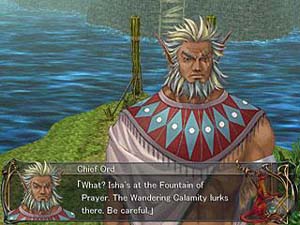
Thank god that war is over. Having embraced all that video games have to offer, I can now play and love quality titles from all developers. Fire Emblem managed to come out with six entries before one was localized for the U.S. The particular one I’m reviewing now is number eight, Sacred Stones, but from what I have read little changes from game to game. →  The Last Readment
Review – Shadow of the Colossus

Shadow of the Colossus
Developed by SCEA
Published by SCEA
Released 10.15.05

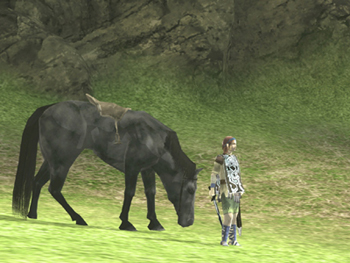
Apparently all reviewers of Shadow of the Colossus must first reveal their Ico credentials. Ico was released in September of 2001, and I had my eye on it from early in its life cycle. For one reason or another I only ended up purchasing the game about a year and a half later. Since then, the more I’ve played the further it has climbed up my list of favorite games. I enjoyed the graphical style, puzzle elements, storyline, I even like the fact that the fighting was terrible, because it made the whole experience of being a young boy lost in a dangerous castle more believable. I felt the same way about the lack of menus and on-screen interface. I fully bought into the idea that the game was art, and the most heartfelt story ever told on the medium. Needless to say, I was excited by the prospect of Shadow of the Colossus. →  Oreshika: Tainted Postlines

Media Station 363

It’s said that Americans want everything in a single package. We want a machine that chops, dices, blends, cooks, roasts, minces, and purees. We want a lawn tool that cuts, mows, prunes, digs, weeds, and buries bodies. The Japanese, however, supposedly want specific devices for each thing. They would rather own more things, each doing what they are designed for very well. I agree with the Japanese; I do not want a cell phone that takes pictures. I want a cell phone that has a long battery life, gets great reception and has clear sound. I do not want a dolly that is also a hand truck, a step ladder land a flatbed cart. Actually, I probably don’t really want any dolly.

So what the hell does this have to do with anything? Half of this generations systems have a built in DVD player (that’s right, I included the Dreamcast. Deal with it), the PSP plays movies, and next gen systems will have all sorts of additional crap. →  I’d rather die than not read this article!

Tech guinea pig

You have likely heard of the two technologies fighting for space in our computer drives and movie players: HD DVD and Blu Ray. Toshiba is the driving force of the former and Sony and Panasonic the defenders of the latter. The HD DVD is cheaper to produce and may be more easily compatible with todays technology but the Blu Ray holds more and is the better technology. But this isn’t a tech article, that would be too useful. If you want to read more about the technology read something like this.

Both formats have a large number of companies behind them. Big movie corporations are on both sides, Apple and Dell are backing the Blu Ray and now Microsoft and Intel have come out in favor of the HD DVD. Some of the discord must be political (not really political, but less about the actual technologies and more about the companies). If Sony is pushing one then Microsoft must align themselves with the other. →  Is that an article in your pants, or are you just happy to read me?

Review – Ys 6: Ark of Napishtim

Ys 6: The Ark of Napishtim
Developed by Falcom Corporation
Published by Konami
Released 2.22.05

Character sprites displayed during key dialog are big and well done.

I lie somewhere between the average gamer, blissfully ignorant of the Ys (said to be pronounced “ease,” but I’ve been saying it “eyes” since I was 7 and I’ll be damned if I’m going to change my life for something as small as the truth) series of games and the ubercore, those who have played every Ys, including both versions of 4. You see, I know enough to know there were two Ys 4s, and I know that this game I’m supposed to be reviewing here, The Ark of Napishtim, is really Ys VI. I managed to play Ys on the Master System when I was a wee lad and then Ys 3 on my Genesis when I was a little older and many are the hours I’ve spent on eBay, contemplating a purchase of a Turbo Duo just so I might play Ys Book 2. →  18 Wheeler American Pro Reader

What are your gaming politics?

Video games are a lot like politics. There are gamers who cry every time someone makes money, those who wouldn’t mind if Electronic Arts bought their children and then some people in the middle. I’ve compiled a list of what I identify as the most common types of gamers and listed their beliefs as seen through a political eye, but keep in mind I am biased by my own beliefs, both political and… gamitical. Call everyone into the room to find out what each other are. It’s fun for the whole family. Sorry, Nazi Gamer isn’t on the list, dad.

Only plays Wisdom Tree titles.

The big two – Most gamers, and decent Americans, fit into one of these two categories.

Liberal Gamer: The possible upcoming game price increase is unnecessary and will only lead to more piracy. What happened to the money we were supposed to save on the change over from carts to CDs anyway? The market exists to serve gamers because we allow the market to exist so the idea that we should all fall to our knees and thank the publishers for giving us games is ridiculous. →  In the beginning games created the heavens and the earth.

Shortcomings of the Emerging Plot

Will Wright bores an audience at the Game Developers Conference.

We have probably all heard the complaint that a game felt like a movie instead of a video game. Echoing this sentiment, a handful of successful developers (Will Wright, for example) has criticized traditional linear story telling in games. Randy Smith, in an interview in “Game Creation and Careers,” describes the difference between embedded narrative and emergent narrative. In the first Thief game, for example, Looking Glass wrote an overarching plot that was presented to the player by cut scenes. This immutable narrative is the embedded part of the story. The emergent narrative is the low level plot, the specifics of what happens throughout each individual mission. By presenting the player with game mechanics that allow him to overcome challenges in multiple ways, Smith argues he is allowing the player to, on some level, write his own story.

The idea that an emergent narrative is as important as or more important than an embedded narrative is misguided (if no one really thinks this and I am attacking straw men, please tell me). →  Read or die.

Micro Madness

The Game Boy Micro is stupid and anyone who denies it is a biased fanboy (as opposed to the more objective fanboy) or a Nintendo employee. The first problem a consumer will notice is the systems price. A hundred bucks for something you probably already have a different version of?

The next obvious problem is the tiny screen. I already have trouble playing action games on my GBA-SP because the screen isn’t very big. The tiny screen is a part of the overall tiny system. This is the major selling point but it’s also one of the best reasons not to buy one. The GBA-SP already hurts my hands. If the SP is designed for Japanese fingers then the Micro is design for Japanese ants’ fingers.

Then there is the competition. If you have the money, just get an SP. It plays more games (original GB and GB Color games, the Micro only plays Advance games), will be easier on your eyes and won’t cause the carpel tunnel to flare up as badly. →  It was the best of games, it was the worst of games

The magic of Shenmue

Perhaps no game or series has ever affected me the way the two Shenmue games have. Because Yu Suzuki was the lead designer, the first game received a good amount of hype leading up to its release, but I was initially unable to play it since I didn’t own a Dreamcast. A short while after the release Jason and I got together, and while we were trying to figure out what to play, he mentioned that he had started Shenmue, but had not gotten very far and was not yet sure if he liked it or not. Fortunately, we chose to restart the game, and barely looked back. Barely only because at first there was a brief period where we were a little unsure what we had gotten ourselves into. The game seemed engrossing, but was it fun? I’m still a little unsure about whether or not I can really answer that question, yet I regularly check the internet for news about a possible third installment, so there must have been something there. →  Call me game-shmael.

UAT ads must die

For the last few months, Game Developer magazine has included ads for the University of Advancing Technology among its otherwise respectable pages. The UAT is an accredited school that offers degrees in game design and other audio/visual fields. The University of Advancing Technology also has the worst advertising I’ve seen in a long time. Their ads appear to be directly aimed towards stupid people, which is a problem because they are advertising courses in game development and we don’t want any more stupid developers making games.

The first example of their atrocious campaign says this –

“Without guys like me, you’d still be playing Pong.”

The quote is attributed to some undergraduate but is probably made up (which actually makes it a lie since it has quotes around it.) This isn’t why it sucks, though. The problem is how pretentious the quote is. It seems to be geared toward what hardcore gamers make fun of as the Play Station generation. This type of gamer is always put off by what they see as sub par graphics, know little of where games came from and are unwilling or unable to appreciate quality design in any game that came out before 1995. →  Game is dead. Game remains dead. And we have killed it.