Review – Doom 3

I didn’t understand all of the hype surrounding the release of Doom 3. So the graphics were cutting edge (assuming you wanted to drop $500 to get your memory and graphics card up to snuff), it was still a game based on a series well-known for having repetitious play and no story line whatsoever. Now don’t get me wrong, I loved playing the first Doom games/expansions, but I had a feeling they wouldn’t hold up if played them years later. I found my fears were correct as I tried to play both 1 and 2 off of the “Special Edition” Xbox game that comes with the entire set on one disc. Fun for the nostalgia, not so much for the gameplay. I made it about fifteen minutes in before moving on to the new game.

HA, I told you guys I could scare him off by myself …. what do you mean “turn around”?

Doom 3, though still quite repetitious, was a little better in the plot area and ended up being much more entertaining than I thought it would be. →  Jesus: Readful Bio Monster

Review – Sam & Max Episode 1: Culture Shock

Well here it is folks. After much trial and delay, the world can finally partake in a new Sam & Max game. Since my only experience with these two characters comes from a handful of viewings of the old Fox Kids cartoon show, my interest in seeing new Sam & Max was quite neutral. Yet my desire to play the new game has been quite high, for no other reason than my great interest in the way in which it was developed. This has to be one of the biggest gambles the industry has seen this generation, one that I hope to see succeed.

After Lucasarts decided to waffle around and eventually can their efforts on a new game, creator Steven Purcell looked towards small developer Telltale Games to start anew. Since Telltale is the brains behind the episodic content of the new Bone game, so too would Sam & Max be released in episodes. Not only that, but Telltale has decided to stick to their guns and create another adventure game for the duo, rather than adapting to modern times and creating something more mainstream. →  You fool. Don’t you understand? No one wishes to read on…

Review – Grand Theft Auto: Liberty City Stories

For this review, I’m afraid I am going to resort to the greatest cop out in games journalism; you are either going to like Liberty City Stories, or you’re not. To some, it is a downgrade from the huge, deep world that was created for San Andreas, a graphically lesser romp through a city we’ve all seen before. Rockstar is just trying to milk their fanbase of even more money, and should be ashamed of themselves. To myself and others, LCS is a technical marvel, (being developed for the PSP), a full fledged GTA experience that combines GTA3’s world with Vice City’s upgrades, all for the cost of a budget game. In this light, Rockstar has given us a nice little gift.

And that’s really it from a review standpoint. Anyone familiar with the series will find no surprises here, save perhaps for seeing Tony Cipriani as a thin gunman rather than a fat restaurant owner. Oh, and the soundtrack is immensely smaller due to the size of the UMD. →  Mrs. Article, you’re trying to seduce me.

Review – Golden Sun

For the most part, the library of video games consists largely of clones of previously successful games. Games such as Grand Theft Auto III have spawned so many sorry attempts at duplication that a whole new sub-genre was born. There was a time when there was only Grand Theft Auto, and the imitators were yet to join the party. So revolutionary titles do happen. They do not happen frequently, and there are plenty of examples of games that tried to establish something new and failed. I think ChoroQ is an example of this. In trying to create an RPG complete with plot, towns, and dungeon exploration within the context of a racing game (or vice versa) the series (which apparently has several iterations on various systems around the world) tried something unique but ended up making a below average game. It is fair to call a spade a spade and say the game was no good while still appreciating the risks it took. →  Of all the words of mice and men, the saddest are, ‘Game Over.’

Review – Mount&Blade

Sometimes games that are incredibly good have no advertising whatsoever. These games are usually made popular by word-of-mouth, if anything (Katamari Damacy for example). Developed by a husband-and-wife team, Mount & Blade is one such game.

I am often distracted while defending my castle by the natural beauty of the setting sun.

I first heard about Mount & Blade half a year ago on a forum. I didn’t try it out at the time, mostly because the authors of the posts were comparing it to Morrowind (which I found incredibly boring). A few months ago, though, I saw it again at a gaming site, this time with a formal, in-depth review that made it sound more interesting. I decided to give it a try and downloaded it.

Mount & Blade isn’t freeware, but it is open-ended shareware. Until you register, you can only get characters to level 6. This boundary was never a problem for me; after six hours of play, I knew I had to pay the $18 and register. →  God of War: Readnarok

Review – Ico

Barely noticed when it was first released, Ico has now become the #1 game to reference when bringing up the issue of art in games. But is it really all that and a bag of potato chips?

Developed by SCEI (Parappa the Rapper, Shadow of the Colossus) and directed by Fumito Ueda, Ico is a third-person adventure game, set in a derelict castle that is situated on top of an island just a few hundred yards off the coast of some unknown continent. Cut-off by ocean on each of its sides, the castle becomes the player’s prison, so to speak.

Ico is a young boy (his name is never referenced, so I’m only guessing it’s his name) that has been shunned by his village and sent to an empty castle to distance himself from society. Why, you ask? Because he grew two beast-like horns on his head, that’s why. Hey, it’s only fair.

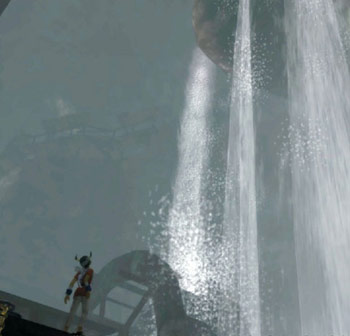
Ico discovers the source of Poland Springs.

Once set in his stone-cell that’s no bigger than a casket, Ico lies in wait…

I’ll keep it at that. →  Shadow of the Article

Review – Prince of Persia: Warrior Within

I’m sure everyone remembers the shitstorm that hit the Internet when Prince of Persia: Warrior Within was released two years ago. An unstoppable tide of criticism and disgust toward the game flowed for months, only getting worse when it ended up outselling The Sands of Time by leagues. (Thankfully, we were spared from having the Prince’s early game cry of “You Bitch!” become the next Internet trend.) However, the most curious thing about the criticism was that very few people ever made any sort of commentary on the actual gameplay. For all intents and purposes, it looked like angry nerds acting as immature and angsty as the kids that Warrior Within was trying to cater to (though that is not to say that I didn’t jump on the bandwagon for some period of time).

Why waste time with sex then violence when you can have sex AND violence?

Somehow I broke out of that funk and got around to playing the game. →  Tell me and I forget. Teach me and I remember. Bore me and I sleep.

Review – Half-Life 2: Episode One

Right now in the world of console gaming, everyone’s favorite buzz term is “HD era”. In PC gaming, it’s all about “episodic content.” Everyone is talking about the concept of delivering smaller chunks of gaming more quickly and possibly with customized content based on user reactions. Unfortunately, the talk is mostly hot air. For one, very few developers have released anything episodic for us to judge, and those that are out there are either a little too indy (Bone) or not quite up to snuff (Sin). Fortunately, the biggest supporters of the idea, Valve Software, have finally given us Half Life 2: Episode 1, the first of many sequel stories to their smash hit. Maybe now we can finally see what this episodic content stuff is all about.

I can think of at least one issue with episodic content; even when we have something to review, how do we review it? The answer might not be so obvious. Look around the ‘net, and you’ll find that most discussion on episodic gaming has nothing to do with quality. →  All happy games are alike; each unhappy game is unhappy in its own way.

Review – Mario & Luigi: Superstar Saga

Games often try to do everything. Some have multiple engines to handle their different systems; platformers have driving bits, and RPGs have action minigames. This is despite the fact that the best known designers — Wright, Crawford, Meiers – say it’s better to make a deep game by the simple interaction of a few parts than to try to do everything. The adage is it’s better to do a few things well than a lot of things poorly.

There are, though, some designers who seem not only content with not sticking to only a few things but who go on record declaring such. David Jaffe has said that he wants to make games that are entirely one offs. He means he doesn’t want to go the traditional route of making an engine, creating some environments and some puzzles to solve/enemies to kill. He wants each scene in the game to be different from the last, a sort of enormous minigame if you will. →  I’ll get a job later, for now I’m going to read this

Review – Sword of the Stars

I’m still not writing to say that MOO2 has been unseated from it’s throne as best 4X space game ever, but Sword of the Stars may be the closest thing to bastard upstart rival capable of causing a genre wide (or at least, Golden Jew wide) civil war. The full game builds upon the demo, showing that the guys at Kerebros know what they’re doing and have created an extremely entertaining, robust game with a great deal of replayability.

This review will be written assuming you read my demo review. If you haven’t, you should go read it. Let me touch upon some high level items first. The one personal pet peeve I have about SOTS is they decided to go the route of “you should discover the intricacies of the game by playing it.” This means the manual is useless and does not dissect all of the racial bonuses, give massive detail of weapon stats, or descriptions of the tech tree. →  I’d buy that for a dollar.