
The first Portal seemed so undeserving of its success. It was essentially a Half-Life 2 mod similar to Research And Development only with a new gameplay gimmick. The story was only added later in the playtesting phase because players were getting bored with room after room of puzzles. Since the developers didn’t have time to model and animate characters a disembodied voice was created from the same disembodied voice that appears in both Half-Life 2 and Team Fortress 2. The end result was barely marketed at all and distributed merely as a small bonus bundled with other “real” games. By all rights, Portal should have been enjoyed for what it was and forgotten afterwards, along with every other short puzzle game. But it wasn’t. Everyone loved the final product, puzzles, storyline, dialog, and all. Even though it lacked any of the budget, violence, sex, and marketing every other game had it did have some kind of magic that other videogames seem to have forgotten. → [post launches in virtual reality],[put on your VR headset now],[left click on your mouse to open the remainder of this post in your web browser on your digital computing device]
Reviews PC
Computer games are a conspiracy to make consumers buy new hardware.
Stalker: Shadow of Chernobyl Non-Review
S.T.A.L.K.E.R.: Shadow of Chernobyl has been a game I’ve declined to review. There are some things I’m just not comfortable casting judgment on. A review implies that the reviewer has authority over the game, an intellectual superiority. I can tell you what I think about Stalker, but Stalker is a complex game full of loose ends; it calls upon a creative power within its players to piece them together. What I think about it is constantly changing the more I play and the more I learn. Any review of the game will say much more about the reviewer than the game itself. This is my non-review. It’s just what I think right now.
I’m going to go ahead and say that I like Stalker–a lot. It’s one of my favorite games ever and I still can’t stop talking about. It has a lot of bad points too, and I don’t believe in homogenous scores so I’m not going to pretend that its good qualities somehow cancel out the many bugs, imbalances, obtuseness, or any other possible complaint everyone has about the game. → Destroy All Articles! 2
Review – AquaNox 2: Revelation
The bottom of the ocean is a lot like space–both are dark and mysterious, both require special equipment in order for us to survive, and both appear as a peaceful shade of blue from our viewpoint. There are, however, some sharp differences between them. No one really goes to space (at least not outside of Earth’s orbit), whereas many people spend lots of their time living underwater. One reason for this is the fact that there isn’t much of anything in space. Every single book, movie, or videogame set in space is forced to make up a bunch of stuff to fill its multi-light-year spanning void. Unless you want to use the Moon as a setting (such as in Moonbase Alpha or the film Moon) then making up a bunch of fantasy stuff is really your only option. Compare this to the ocean, which is full of unearthly landscapes, mysterious wreckages, and more life than we’ve even be able to document.
Review – Burger Island
I recently [not recently – Ed.] spent a good portion of my Memorial Day weekend remembering our fallen soldiers by playing Burger Island with my daughter.
“Do you want a turn making milkshakes, daddy?” she asked in a cute manner.
“I will do it! I will do it for those that died at Normandy!” I cried.
And thus began my nightmarish decent into the maddening world of Burger Island.
Burger Island, I learned the hard way while simultaneously paying tribute to the ultimate sacrifice of others, is a lie.
The island in the title is not a gigantic delicious hamburger. It is not a Burger Island. The point of the game is not to gorge your stranded survivor on the island itself in the name of survival, slowly eating the very piece of juicy, flame-broiled land that also keeps you safe. You do not delicately balance the all-encompassing hunger of the main character against the need to stay afloat upon something, even if that something is food. → Ask not for whom the game plays, it plays for thee.
Review – League of Legends: Season One
Following many months of “live,” but not “ranked” gameplay, League of Legends, published by Riot Games, has gone pro, launching their competitive Season One. Featuring several ranked ladder modes: “solo” (actually solo or duo play) 5v5, full premade 5v5 and full premade 3v3, the ladders will culminate with tournament play and $100,000 of cash and prizes. Although Riot will not release simultaneous usage numbers, they have confirmed through various online sources they have over 3 million registered accounts. With the DOTA community estimated at 7-9 million players built over a decade, Riot should be proud of how quickly their game has caught on and distinguished itself in broad field of incumbents and competitors.
Unsurprisingly, Season One is mostly more of the same. On the cosmetic side, both the website and the game’s launcher UI received new snazzy themes and sound track. For the game itself, beyond the usual patch changes of balance tweaks and a new hero, a draft mode was implemented for competitive play. → Shadow of Read
Review – Dragon Age: Origins
The machine slowly comes to life, the sound of whirring fans and arcane instruments powering up to a deafening howl. Then a blinding flash of incandescence, a painful sense of sudden detachment from where and when you were. Also all your clothes are apparently gone, unfortunately burnt away by the paradox. Uh-oh.
Yes, playing Dragon Age is like taking a trip back in time. Not back to the pseudo-historical-yet-entirely-fictional fantasy universe it is set in, because it never happened! I’m telling you, all that conspiracy theory stuff about William the Conqueror using dragons at Hastings is completely bogus. I was there, it never happened, no chance.
No, the time it takes you back to is around 2004, when the game was first announced. It was an extended development process, and as is often the case, elements of the game feel dated as a result. But mostly in a good way. While Bioware took things off in a completely different direction with the Mass Effect series, all streamlined, shiny sci-fi action, Dragon Age is much more of an RPG throwback. → Can you read me now?
Armored Princess Review: Part III
When I initially conceived of the idea of writing episodic reviews I planned on concluding the series when I had also finished the game. Well I haven’t finished Armored Princess yet, but it’s also been almost two months since I posted part one of this review. I think the time has come to wrap this up. Actually it’s probably way past time. But better late than never I suppose.
Anyway, I spent part one and part two talking about different individual aspects of the game, so I’ll finish this by summarizing my feelings of the game as a whole.
THE REVIEW OF THE ARMORED PRINCESS
– Part III: The End is Another Beginning –
This is the kind of game that I enjoy playing for reasons completely unrelated to any of the gameplay or presentation that I’ve mentioned so far. I’m always the most satisfied with a game that completely takes advantage of the hardware it’s made for, and the King’s Bounty games fully utilize the PC. → Ultima IV: Quest of the Avatarticle
Review – Torchlight
Torchlight should be branded with a warning. The game is pornographic, it’s number porn and clicking porn with a Tolkienesque fantasy fetish thrown into the mix. After loading the game there is a brief introduction to set the scene, and immediately the player begins clicking madly on everything moving.
With each click the characters moan, scream, and produce other sounds juicy with stimulation. Of course it’s not the meaning of the sound they make, it’s the fact that each of these noises is calculated to be so brief and repetitious, fading in and out instantly and producing a peak at just the right tone. It elicits pleasure in the player’s brain, and without thinking he or she understands that another such buzz is only a click away. When the clicking is finished, the number action begins. The screen fills itself with numbers. They sprawl across each other, mixing together, interacting to produce more numbers. They grow bigger and bigger, until they climax and the game returns to the clicking. → The Read Star
Review – Children of the Nile / Alexandria
Children of the Nile is a continuation, and possibly the final installment of the fairly successful Pharaoh series, taking advantage of the excellent setting of ancient Egypt as a basis for a robust city builder. The people of ancient Egypt are civilized enough to be needy bastards– a prerequisite for any builder, and in an era filled with war and great deeds, we’re off to the races of conquest and glory.
COTN’s greatest strength, without a doubt, is the ecosystem of its city. Your people have multiple “tiers” of social standing, with each level having its own behavior and needs. Your job, of course, is to keep those needs satisfied so their efforts can be directed towards doing useful things for you: killing your enemies and building great works in your name.
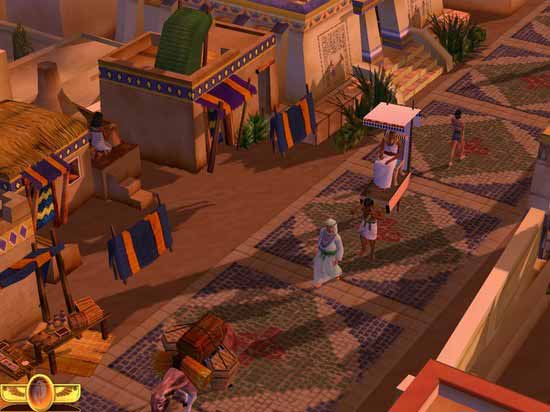
There are two backbones of the COTN experience: food, which serves as universal currency in a barter system, and the satisfaction of needs. Food is harvested by farmers, of course, and then wends its way through a variety of nobles (through taxes) and shopkeeps (for purchase of common and luxury goods, keys to happiness for your people). → Actraiser Readnaissance
Armored Princess Review: Part II
Sometime while I was busy writing about how much the PC is awesome and how much BioShock sucks I realized that I was still actively playing King’s Bounty: Armored Princess and I’m overdue in my second review installment. I’m probably about half way through the game at this point. Considering I’ve spent a total of 35 hours so far, part of my brain is telling me to play something else that I have hope of finishing; but I just keep trudging on anyway.
Part 1 was about the world of Armored Princess. It dealt with things that people tend to think don’t matter in games. Whenever a critic rambles on about inconsistent details in fantasy worlds then they can expect insane fans to blow their comment section through the roof with defamatory accusations. Fortunately my reviews don’t get featured on Metacritic so no one cares about them and Armored Princess doesn’t have a lot of fans anyway. But the fans it does have might appreciate this review since it’s about a thing that supposedly is all that matters in a game: the gameplay. → Jesus: Readful Bio Monster