
Review – Infinite Space

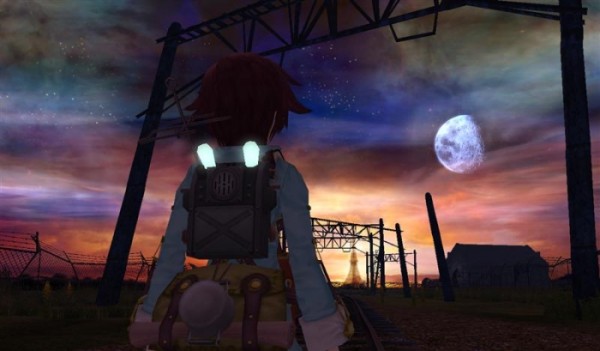
As a fan of the occasional science fiction novel, I’ve wanted to see a real sci-fi JRPG for a long time. The Star Ocean series occasionally tantalizes – then I’m reminded once again that the vast majority of each Star Ocean game ends up being the standard medieval fantasy-themed magic-filled claptrap anyway (or super-science with no explanation, which as we know is indistinguishable from the former). The Phantasy Star games have a science-y atmosphere, but they’re more post-apocalyptic in nature and there are only bits and pieces of the sci-fi around. Xenogears and Xenosaga probably come closest, but the former was more fantasy themed and the latter was too focused on inappropriate religious references to bother with much science, despite all the spaceships flying around and weapons research going on.

I ultimately expected Infinite Space to be the same sort of disappointment, and was pleasantly surprised. →  Read, I am your father!

Review – SaGa 2 DS

Akitoshi Kawazu has sort of a shaky reputation among RPG fanatics.  He gets the occasional hit – if you can indeed call them that – with games like Final Fantasy Crystal Chronicles.  More often he makes games that have only a niche following at best.  He’s best known for his work on the SaGa series, which hasn’t had a great game in a long time.  I suppose you might be able to find a few people who liked SaGa Frontier or Unlimited SaGa, but then some people like pain and insurmountable learning curves.

There’s one game, however, for which I have to really give him credit.  Among the first creations that were wholly Kawazu’s was SaGa2 on Game Boy, which we saw as Final Fantasy Legend 2.  Its huge variety of settings, equipment, and character types appeal to me just as much as a solid, well told plot and more than magnificent graphics.  →  To be this lame takes ages.

Review – Sands of Destruction

How is it that nobody can make a good JRPG for the DS? Some remakes have been all right, and a strategy RPG or two have been good. But every original RPG for the system seems somehow tainted by the platform. Black Sigil, Nostalgia, Beyond the Yellow Brick Road – hell, even a Suikoden spin-off was barely up to par on the system. Sands of Destruction is sadly no exception.

This isn’t to say it’s a bad game. Sands of Destruction’s problem isn’t that it’s actually bad – it’s just that it’s never good. It manages to be almost entirely middle-of-the-road throughout, with no particularly exciting moments and only a few terribly boring ones. Its plot has an interesting premise, but gets dragged down by bland characters and predictable twists. →  The Lord of the Rings: The Fellowship of the Read

Review – Vandal Hearts: Flame of Judgment

Watching a beloved series re-emerge after years of lying dormant is always disconcerting. On the one hand, it’s nice to see developers expand on a world already well-fleshed out and attempt to recapture something that was thought lost forever. On the other hand, it may be worse to have a crappy sequel than to have no sequel at all. Worst of all would be a sequel that’s good enough to look promising and manages to recreate many of the best elements of the series, but ends up being mediocre and only dulls the series in the fans’ eyes. The last, unfortunately, is the case with Vandal Hearts: Flame of Judgment, a western-developed entry in Konami’s strategy RPG series.

It’s not that the game doesn’t have good elements. On the contrary, it’s brimming with promise: there’s an impressively deep skill system that makes leveling transparent and continual; variety in the missions ultimately makes several scenarios better than many in the original Vandal Hearts games; bonus “treasure” maps allow for hidden stages, and skirmish maps let the grind-lovers do their thing. →  Sly 3: Honor Among Reads

Review – Shadow Hearts

Continuing my trend of catching up on PS2 RPGs, I picked up the Shadow Hearts series a few months ago. Since a recent spate of games (including Demon’s Souls, which seems to be a videolamer favorite) has kept me busy, I’m just now making my way through the series. The PS2 may have an impressive spread of RPGs – as I’ve discovered, still playing games I had barely heard about – but Shadow Hearts really stands apart, despite being an early game on the system that hasn’t really aged well.

By far the most impressive part of Shadow Hearts is the atmosphere. Set a little over a year before World War I and taking place in both East Asia and Western Europe, SH manages to portray a surprisingly realistic world, given its focus on demons both internal and external. →  May God smite me if I stop reading here!

Review – Persona

Nothing but Playstation remakes. The PSP seems to be relegated to the unusual role of a “Remake system”. Nearly all the RPGs (which are, of course, the only real games out there) on the system are remakes, or generally reputed to be bad. And Persona is falls neatly in the first category, as you might expect.

But as I’ve written before – the Persona we received back when it was among the first in its genre for the Playstation wasn’t quite the same game they saw in Japan. Set in the sleepy US town of Lunarvale (which still managed to house a several-storied corporate office), the American students (who all wear school uniforms and are taught in a traditional Japanese concrete-block school) face an invasion of demons from an unknown source. →  Knock knock. Who’s there? This article.

Review – Digital Devil Saga 2

I have heard it said that the second Digital Devil Saga was rushed. The four hour long final dungeon might be evidence of this, given that the whole game is still only about 25 hours long total. This makes DDS2 only a bit longer than the first one. While DDS2 maintains the solid Press combat system of the first game, in terms of scope and story, it is leaps and bounds more engrossing.

In Digital Devil Saga 1, the player would often find himself wondering what in the blazes could be going on. Each new answer brought with it two or three new questions, making for a veritable hydra of a storyline. While DDS was interesting enough on its own, DDS2 actually does answer all of these questions. It adds a few more at the end, but they are the usual questions one might expect of the genre – “What is the nature of mankind?”, →  Romance of the Three Articles IV: Post of Fire

Review – Digital Devil Saga

Atlus has a reputation for releasing games that appreciate in value. They print a bunch of copies, but they sell slowly at first but eventually you’ll need to trade in a console or two to have enough credit to pick them up.

Recently, they have been trying to curb that reputation – partly by printing more copies of new titles, but also by reprinting old games. Shortly before the ultimate demise of the PS1, they reprinted Persona 2, for example. More recently, they reprinted three Shin Megami Tensei PS2 games: Nocturne and the two Digital Devil Saga games, each of which had been selling for more than $60 for a good while.

Being the dedicated RPG enthusiast I am, I completed my PS2 SMT collection with the two DDSes when I heard the news. →  The Last Readment

A Farewell to (Wild) Arms

One of the first RPGs to land on the Playstation in 1997 was an unassuming, Old West-inspired game by the name of Wild Arms. Though it never managed to compete with more mainstream series, it has a greatness all its own; with a solid difficulty balance, a variety of puzzles, and a plot that dwells more on loneliness and a decaying world than on long-haired villains or a large but irrelevant main cast, I consider it one of the best RPGs on the system.

In the past couple weeks, the news got out that Akifumi Kaneko, the lead designer and scenario writer for the entire Wild Arms series, left Media.Vision in 2008. This came a couple years after Michiko Naruke, who had been the primary composer for the first four games, had stopped working on the series due to illness. →  Please sir, can I have some more?

Review – Black Sigil

Black Sigil screamed promise. After being impressed and occasionally a bit burned with indie games, a DS game by a small but dedicated team of RPG fans sounded really good. Graphically inspired by Chrono Trigger, its visuals are both nostalgic and fresh on a system that needs more sprite-based games. Even after the release date was pushed back… and back… and back, I still was somewhat excited upon its release.

I maintained this excitement through the first area. The first section is mostly story, but your initial quest is to walk to an area on the world map. “You walk a little slowly”, I thought, “but that’s okay – surely they’ll eventually give me a boat, hovercraft, flying castle, etc.” And then the random encounters started. And continued. I had at least ten encounters on the way, and each one played out exactly the same way. →  Ultima IV: Quest of the Avatarticle