
Faxanadu and Crystalis

I’d like to bring a couple of old games to your attention. To me, these games pioneered the Action/RPG genre, which sadly has not received the attention it deserves.

First on the list is Faxanadu. An offshoot of the Dragon Slayer series in Japan (of which we received Faxanadu and Legacy of the Wizard), Faxanadu has much in the way of fantasy stereotypes: your character is an elf, and your mission is to make your way to the World Tree and track down those crazy dwarves who keep shutting off the elves’ water supply (thereby bringing about the deterioration of the world, etc, etc).

Although the plot is there, it is not particularly interesting. The important part is that you keep exploring, crossing vast expanses of diverse terrain, and you fight whatever gets in your way with magic, swords, and items. →  Oreshika: Tainted Postlines

A brief survey of localiztions

Ever since the first text-based game came from Japan to American shores, those playing have wondered, “What did the original text say?”

…Well, I have, at least since I was old enough to tell the difference between “A winner is you” and real English. Hearing about and playing odd translations of games is a bit of a hobby of mine.

Thankfully, translations in general are getting much better. Voice acting is much, much better than it has been in the past, although it can still use some work. Let’s look at some localizations past and present as evidence.

Good Localizations

These games leave you with a good feel for spirit of the game. They rarely if ever have grammatical problems, and if there is any voice acting it is well-produced. →  Hot Shots Post 3

Stop mixing my drinks

So I was playing Final Fantasy XII for the first time when I noticed the game had a lot of concepts that look like they came from science fiction. Ships looking like they came from Star Wars fly around in the intro, shield-like barriers are being used to protect cities, that kind of stuff.

This wouldn’t really bother me that much, but it seems like regular medieval fantasy has become a lost art. Final Fantasy gradually made the transition from medieval to steampunk-esque to post-apocalyptic to an improbable-looking science fiction. I would have no problem with this transition normally — on the contrary, more science fiction RPGs would be nice too. But the story and atmosphere most of the time remain in the fantasy style. →  Screw Jesus, this article’s the real deal

The beginnings of a Culdcept addiction

I first saw Culdcept a while back, when it was just released. The back of the box made it seem pretty interesting, but the price just wasn’t right for the game – I’d seen maybe one review and it was lukewarm at best.

The other day, though, I saw it for $10 and thought, “Perfect.” I snatched it up and I think I’ve found a new addiction.

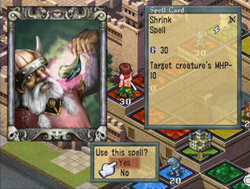
What makes this game most interesting is, naturally, the gameplay. It’s perfectly suited to the card-collecting aspects of Magic: The Gathering (or pick your favorite new CCG), while it retains some of the feel of classic board games like Monopoly. The artwork on the cards reinforces the former, while the cartoony feel on the game board complements the latter. →  Monster Reader 4

Chris loves Jesus part 2

Continued from Part 1

The casual (or obsessive?) reader may ask, “How does one foster a personal relationship with Jesus?” The best way for me was to translate it.

Don’t look at it too long or your brain will melt.

Long, long ago in a mindset far, far away I decided to translate a Famicom game by the name of Jesus: Kyoufu no Bio Monster. Despite all the difficult aspects of both translation and ROM hacking, I managed to create a patch that (I hope) carries across much of the feeling of the game.

The first task, naturally, was to figure out what in the hell was happening in the game. I could figure out the basics between context and the words I already knew. →  Frankly my dear, I don’t read a damn.

Chris loves Jesus part 1

I’d like to tell you all a little story about me and my friend named Jesus. No, not that Jesus… This Jesus doesn’t save. It uses passwords instead.

I like women who match their bedrooms.

When it comes to obscure and unknown games, it takes a lot to get much less known than Jesus: Dreadful Bio-Monster. Although it came out on several systems in Japan, it saw no English release. Despite the – somewhat recognizable – name, the game bears no teachings, or indeed any characters somewhat resembling, the well-known founder of Christianity (in fact, the name refers to a space station in the game). There is a bio-monster, however, and it inspires dread.

Jesus is an adventure survival horror game developed by Enix and published by King Records. →  Did I do that?

Review – Mount&Blade

Sometimes games that are incredibly good have no advertising whatsoever. These games are usually made popular by word-of-mouth, if anything (Katamari Damacy for example). Developed by a husband-and-wife team, Mount & Blade is one such game.

I am often distracted while defending my castle by the natural beauty of the setting sun.

I first heard about Mount & Blade half a year ago on a forum. I didn’t try it out at the time, mostly because the authors of the posts were comparing it to Morrowind (which I found incredibly boring). A few months ago, though, I saw it again at a gaming site, this time with a formal, in-depth review that made it sound more interesting. I decided to give it a try and downloaded it. →  Ask not what this post can do for you - ask what you can do for this post.