Review – Final Fantasy Tactics Advance 2

On Gameplay: the battle system, the law system, and quests

Golden Jew
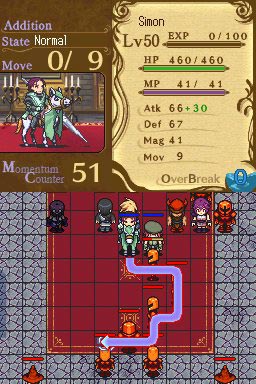
Before you pick up a copy of Tactics A2, there’s a simple question you need to ask yourself. “Do I love SRPG battles?” It’s really quite simple because this game is basically a lot of tactics battles. For the most part, random encounters have been eliminated and are instead replaced with 300 quests for you to complete.

Augmenting pixilated slaughter, there are run and fetch quests, and a few “dispatch the right person” quests, where the fun lies in trying to figure out what the proper class/race is. For example, an intuitive one asks for a sexy barmaid – so of course you send a viera. But others are slightly more obscure and can be irritating (and therefore FAQ-worthy). →  An article approaches.
- Read
- Run

Rearmed and Ready – Are you?

Bionic Commando: Rearmed is now out in all intended formats. If you have one of these formats, and you love the challenge and the feel of classic 2d games, I hope you have it already. If you don’t, might I suggest you give it a download? Until Mega Man 9 hopefully rocks our socks, this is the best thing to come around this year for retro enthusiasts, except for maybe Space Invaders Extreme or Bangai-O Spirits. I don’t want to go too far into discussion (save that for the review!), but suffice it to say that this is a remake that gets it. It feels right, both old and new, careful and bold. Its the kind of game where just seeing it in action makes me happy. →  Lords of the Read 2

Review – Seven Kingdoms: Conquest

Imagine throwing the major pre-gunpowder empires in history into a grand free-for-all. The Japanese would have samurai and ninja, Vikings would have axethrowers and berserkers, Normans would have crossbowmen and knights, and so on. Now imagine adding in random demon lairs that attack human settlements. This is the setting of Seven Kingdoms, an RTS with several fairly deep mechanics, including unit loyalty, economy balancing, and a great espionage system. Its sequel would go on to refine each of these, adding more civilizations and the ability to play as the demonic races of the Fryhtans. Both have a deep complexity that keeps me playing when other RTS games start to feel too shallow.

Unfortunately, I am reviewing neither of these games here. →  Oreshika: Tainted Postlines

Review – Alone in the Dark

Apparently, it is becoming the rule rather than the exception for games to be rushed to release, rather than given the time to properly simmer. There are a slew of factors causing this, such as soaring costs, tricky console hardware, and the fickle, tiny window of attention that the hype machine grants.

Of course, a rushed game can come in different flavors. In my last review, we saw how Army of Two lost most of its grand cooperative aspirations, but still managed to ship as a stable and competent action game. From a business perspective, this is acceptable as gamers will buy something derivative if it is polished well enough.

Another result is something like Alone in the Dark, where the grandiose ideas remain, but are held together by duct tape and the hope that bugs and glitches are not severe enough to cause the game to crash out from under the player’s feet. →  Onimusha 2: Samuread’s Destiny

Review – Song Summoner

A game for the iPod? Don’t make me laugh! It’s one of those puzzle games, right? Maybe trivia? Rhythm-based? Well, “rhythm” is getting a bit closer. Of all the genres I thought I’d see on the iPod, a Strategy RPG would be last. Hence why, a mere day after hearing about Song Summoner, I bought it and gave it a try.

When you’re not expecting much, a game can amaze simply by being mediocre. This game cost me about the same as a fast-food meal, and I expected it to keep me entertained about as long. It exceeded my expectations – with decent style and good artwork and music – even though I can’t recommend it against many other strategy RPGs. →  Snap! Crackle! Read!

Review – Jake Hunter

You likely play video games for one of the following reasons:

To enjoy fun gameplay
To be amazed by pretty graphics
To fall in love with characters
To listen to an enthralling score
To read a well written story
To kill time because your life is entirely devoid of meaning, even fake, self-created, existentialist meaning

Bad news for those who play primarily for any of the first five reasons – Jake Hunter fulfills none of them.

The Hazakura temple or Neo Olde Tokyo would be nice.

Adventure games, specifically Japanese text adventure games, tend to lack dynamic gameplay and, as such, have a niche audience. If you enjoyed Phoenix Wright or Hotel Dusk you likely don’t mind game mechanics that are under-developed and only there to bridge text box A with text box B. →  I’d buy that for a dollar.

Review – Army of Two

Army of Two is an attempt at many things, one of which is to capitalize on the recent enthusiasm for cooperative games. Co-op is arguably the number one most important bullet point a game can have in its press release. Even if it is hardly suitable for the game at hand, excluding it will cause many people not to buy your product.

In order to distinguish itself from the deluge of co-op titles, Army of Two attempts to integrate cooperative measures into every aspect of the game. It also tries to deliver some social commentary like so many hotshot developers and players crave in their desire to legitimize their hobby. Ultimately, the game shares the same major fault of so many of its competitors: it was rushed. →  Now bear my arctic post.

RPGs are bad “games”

The JRPG genre is filled to the brim with games that are so ridiculously easy they are bad “games” – in the sense that a game is something you should have to play optimally to achieve success. The Suikoden series, my favorite of the past two generations, has gone from being “somewhat tricky in one or two battles” to “a breeze at its hardest, with pretty much no thought involved.”

Part of this is a plague of the genre – the phenomenon of grinding. For those who don’t want to think about what they’re doing, grinding is an easy way out. There’s no need to play perfectly when you can spend a few hours killing baddies and come back able to beat the tar out of the bigger baddies. →  Readlevania

Review – Rondo of Swords

What we have already played shapes our opinions of new games. To an SRPG fan, a game like Luminous Arc is old hat. Yet people new to the genre may be taken in by the musical score, voice acting, interesting story and quality breast-focused character art. Without knowing what has come before, the game seems competent enough and can provide some good strategic fun.

The experienced SRPG fan likely sees Luminous Arc in a very different light. Its serviceable gameplay is often boring and it does very little to distinguish itself from older SRPGs beyond the innovative addition of painful load times between character turns. If you have played an SRPG or two in the past few years you will miss little by ignoring Luminous Arc. →  Garou: Mark of the Posts