Review – God of War 2

Here is a checklist of some of the highlights from the original God of War: challenge a god, escape from Hades after being killed, defeat numerous figures from Greek mythology, murder a soldier in order to solve a puzzle, travel to a variety of shiny temples, hunt down ancient treasures in order to face your foes, obtain mythical powers from the gods. Like it or not, the pieces came together to make a game that was more than merely successful.

But what happens when the sequel does the exact same thing? The story, gameplay, pacing and visual style of God of War 2 is almost identical, as if they took the old checklist from the drawer, rearranged a few things, and got right to work on making enough behind the scenes features to span their own disc, which I suppose proves how much more work they did compared to the first time.

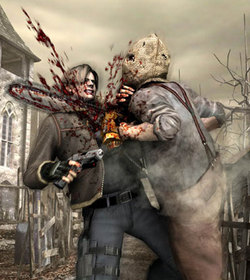
Luckily for Kratos, this baddy doesn’t realize that if he stopped flailing his legs he would still be standing on solid ground.
 →  Some say the world will end in fire, some say in read more

Review – Sam & Max Episode 6: Bright Side of The Moon

Here it is, the final episode in the only episodic series that’s actually managed to do something with itself. Six games in as many months is something that Telltale Games should be proud of, but they get another pat on the back for doing such a good job. Season 1 was very much a learning experience, both for themselves and for the fans. Throughout the journey, Telltale has shown definite signs of listening to their audience and learning from their mistakes. Bright Side of the Moon fixes a lot of problems from past episodes, and is all-around the most solid effort of the six games. Funny, lengthy and fun to play, I was sad to see this one come to an end.

The first five episodes sometimes struggled with the balancing act of keeping the puzzles tough but not obtuse and also keeping the humor strong, all in a very tight timeframe. Sometimes it worked, sometimes it didn’t, and ultimately Ep. →  Xenosaga 2: Jenseits von Gut und Pöst

Review – Trace Memory

I’m not usually a big fan of the point-and-click adventure genre. Myst never managed to keep my attention, despite the rave reviews it got way back when, and the one Kyrandia game I played only managed to entertain because of the constant humor. I haven’t even gotten more than half an hour into The Longest Journey in the two years I’ve had it.

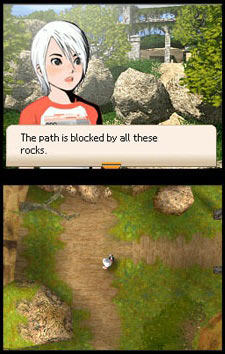
Oh well, looks like the game’s over.

Trace Memory, though, managed to keep me engaged through to the end. Even when Puzzle Quest failed to interest me, I continued to play Trace Memory. It could be that the medium keeps the idea of the game interesting. This was my only DS with a particularly compelling or deep story I hadn’t beaten, and I think that was a big part of what kept me motivated. I enjoy playing story-heavy games, and they aren’t very common on portable systems, so I try to play as many as I can get my hands on. →  The Last Readment

Review – Soul Calibur 3

Soul Calibur 3’s is like a reunion tour, featuring every character in the franchise, as well as classic stages and songs. It also boasts a huge level of customization, right down to the ability to create your own character. It seems to be everything you could ask for, but in order to experience it, you’re going to have to play by the game’s rules, very strict rules that state that if you want to enjoy some of it, you’ll have to slave through all of it.

Soul Calibur 3 is the Square-Enix of fighting games, so proud of its accomplishments that it doesn’t give you a choice about whether you want to see it all, so ashamed of its old school roots that it hides them far away from the player, as if to scold them for ever wanting to dig them up. It’s a lazy and pandering game that should be so much more.

The first thing you will notice about Soul Calibur 3 is that the menus are a mess. →  Romance of the Three Articles IV: Post of Fire

Review – Sam & Max Episode 5: Reality 2.0

Despite it being the penultimate episode of Season 1, I don’t have much to say about Reality 2.0. It repeats much of the same things we’ve already gone over (ie, “The rule of three” for puzzles, familiar faces and environments, etc.). Reminiscent of ep. 4, it has two very hard puzzles with some very easy stuff in between. At this point it is rather useless to discuss whether any of these things are good or bad, because they are simply the way they are.

When episodic content is released in a matter of weeks rather than months, there is a very limited time in which to create new content. Some things are going to be static, both because it fits the nature of the game (“episodes” of any sort of media don’t completely change), and because it is the only way to get the content out quickly.

Reality 2.0 does bring up some important issues. Firstly, it shows that Telltale can reuse the same people and places and have them still feel fresh. →  Ring of Read

Review – Godfather: Blackhand Edition

There seems to be a belief among some third party developers that in order to make a Wii game, it is essential to attach meaningless gestures to everything you do. The best example is Red Steel, which forces the player to drag and drop icons on the main menu or shake the remote several times to open a door (because the first time it didn’t respond properly). This leads to cranky reviewers dropping two, maybe even three points from their final score because they simply can’t be bothered with such annoyances.

Then you have a game like The Godfather: Blackhand Edition. None of its menus require Wii gestures. When you swing the remote to open a door, it actually works. Or you can just hit the A button and be done with it. A lot of folks have worried about the Wii receiving lackluster ports with tacked on Wii controls, but with The Godfather EA has found the sweet spot, providing us with an already good game and making it better with motion controls that are logical, responsive, and never unnecessary. →  Postgaea 2: Cursed Memories

Best Game Ever / Review – Dragon’s Trap / Curse

It’s somewhat bizarre that my normally useless extensive knowledge of the Sega Master System would come in handy because a Turbo Grafix 16 game is released on the Wii. But despite the comical circuitousness, I happen to know a thing or two about Dragon’s Curse. You see, as far as Master System games go, this game is anything but obscure. It’s actually so beloved that a great Master System emulator is named after the game.

In an attempt to completely confuse America as revenge for dropping atomic bombs on them, Japan has seen it fit to rename the game called Dragon’s Trap (Master System) for release on the TG16, where it would be called Dragon’s Curse. That wouldn’t be very good retaliation, though, considering the cancer rates are still abnormally high in Nagasaki and Hiroshima. So to make things harder, this game is also known in the states as Wonder Boy 3 the Dragon’s Trap, or Monster World 2.

OK, Wonder Boy 2 for the Master System is actually Monster Land 1, though it’s called Monster World 1 in Japan. →  Theme Postital

Review – God of War

I hate making film to videogame comparisons, but in this case it seems appropriate. Back in the day, whenever a movie ended explicitly detailing that a sequel would be made, it always bugged me. Who the hell did those guys think they are? Were they really that confident in their production, or were they just cocky? It always seemed to be in bad taste to just assume people were going to buy in to your product.

Nowadays, the sequel hint is a common practice. Not only do we generally accept it, but sometimes we downright expect it (as in the case with something like Spiderman). After all, if it is good, then why not create even more of that good for us to enjoy?

The same logic seems to have carried over into gaming-land. Regardless of whether it hints at a sequel, if a game is good, we expect to see more of it. And not just one sequel mind you – few of us are phased when it grows into an entire franchise stretched over every platform. →  Think outside the post.

Review – Second Sight

I’ve come to believe strongly in a particular rule taught to me by wiser gamers. The rule states that “if a game wants to entice me, to keep me playing, then it cannot assume I have nothing better to do than to play video games.” It’s hard phrase to describe exactly what the phrase means, but it pertains to certain bad things modern games like to do. Sometimes they’re done to artificially lengthen playtime, sometimes they’re done to help introduce new players. Sometimes it is to enhance the cinematic nature of the game, or to keep things “realistic.” Whether they are done because of a current trend, or to try to overcome a particular design hurdle, these additions hurt more than they help. They can cause repetition, make the player jump through hoops, and completely destroy any suspension of disbelief. We play so that we can get away, to do things we couldn’t do otherwise, but that doesn’t mean we want to spend that time dealing with bullshit. →  An article approaches.
- Read
- Run

Review – Wario Ware Smooth Moves

Wario Ware Smooth Moves for the Wii — In playing this game I discovered a maxim that holds true. In observing my personal failures and some of my friend’s successes in playing the Wario Ware mini games, I discovered this: The extent to which you are good at Wario Ware is the extent to which you are a bastard. This is because Wario Ware has been created to reward the wicked and punish those of us with dignity and gameplay standards like functional controls or knowing game objectives before you lose. Wario Ware apologists would have you believe that the minigames are varied, fun, and fair — but they would be lying. 80% of the games can be won only by shaking the remote, or occasionally waving it around or throwing it at your friend.

Most Wario Ware fans don’t realize that you can do this IRL, too.

Here is a list of the minigames available in Wario Ware:

Shake the remote to shuffle papers
Shake the remote to put out a fire
Shake the remote to grate cheese
Shake the remote to grind an herb
Shake the remote to open some curtains
Shake the remote to seduce an older woman
Shake the remote to hula-hoop
Shake the remote to roast some meat
Shake the remote to put-down an injured dog
Use the remote to balance a broom on screen, in the simulated gravity of Jupiter
Wave the remote around to pick up an apple
Use the remote to guide fingers into orifices
Throw the remote at the TV as hard as you can (this minigame can be improvised during any other minigame)

If the games are so simple, you might ask, then how does anyone lose? →  Final Fantasy Mystic Post