
The Trouble with Tactics

As I’m sure you can tell by my previous articles, I love RPGs and strategy games. It should follow, then, that I love the Strategy RPG genre. Just like peanut butter and pizza. Although I like some SRPGs, I have some issues with the genre, particularly the Tactical subgenre. By “Tactical”, I mean finer-scale games where you manage each individual taking part in battles.

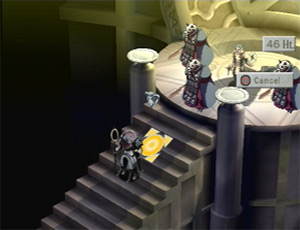
For example, I started up Shining Force a couple months ago via the wonders of Virtual Console. I began noticing occasional oddities; enemies with low agility would move twice when my high-agility archers never got a move in, for example (Hans was useless anyways). Levels would either be quite useful or really suck.

You can’t tell from this picture, but the priest and thief are horribly under-leveled.
 →  Think outside the post.

Review – Growlanser: Heritage of War

The third Growlanser game we’ve received stateside, Heritage of War, is actually the fifth in the series. We received Growlansers 2 and 3 as the last games of the late Working Designs (what is Gaijinworks up to, anyways?) in the Generations package. This game is a more than adequate successor.

Similar to the third Growlanser, Heritage of War is a Strategy RPG with leanings toward the RPG side. You move around the world exploring cities and caves, but when a battle starts, you enter a sort of active-time strategy mode in which you can pause anytime to give orders to any of your allies. For those of you who’ve tried Final Fantasy XII, it’s a lot like that with a faster pace and pausing while giving orders. →  Final Fantasy Mystic Post

Two years down, too many to go

In the past two years I have learned, among other things, how much more there is to learn.

First, from meeting and talking with Jay and co. here at videolamer, I learned about all the great RPG, strategy, action and adventure games on the various Sega systems I missed out on. I even tried out Phantasy Star 1 (a mistake, as I have grown soft and weak with puffball RPGs) at Jay’s suggestion, and bought a Sega Saturn, a mod chip, and a few games as well. In fact, don’t tell him, but with a bit more nudging I might start looking for a Dreamcast soon. Due to similarly sinister influences, I have found the “new old Sega console” – the underdog of the last generation, the Gamecube, and will be working on remedying the last 4 years of missing out on an entire system’s worth of good games. →  If you die in the article, you die in real life.

Revelation of Arcadia

It’s not often that a single game has changed my outlook on games so much – especially in the RPG genre, which seems to see only occasional innovation. Usually it’s in the form of a plot twist here or a stylistic change there that is incorporated into a group of cliches. While some carry an idea out a bit better, and a cliche-filled game can still be a lot of fun, many games feel like a string of cliches in a different order with a new battle system.

For a long time, I really thought I didn’t care much. Oh, the first Persona was neat and all, and the Suikoden series’ focus on larger events was cool, but it was the nifty, well-done battle systems that I convinced myself I really enjoyed the most. →  Read Theft Auto 4

Review update – Mount&Blade

It’s been over a year since my first article here on videolamer, in which I reviewed the PC Action/Strategy/RPG hybrid Mount & Blade. I didn’t mention it in the original review, but good old M&B is still under development. The version I reviewed was somewhere about 0.75; the current version, released just a few days ago, is 0.901.

And what changes have come! In .890, there was a major combat overhaul, the addition of three new factions in “vanilla” (the regular, un-modded game), as well as a troop tree for each faction. The game plays better than it ever has before; combat is quick without feeling unnatural, trading remains profitable, and veteran mercenaries are available early on.

For those who didn’t read my original review, a quick overview: Mount & Blade is a medieval FPS RPG. →  All this can be yours, if the read is right.

Destiny of a Fan

Everyone has a couple of games they particularly like, regardless of how good they are, because of the memories they have of them. Unless, of course, they don’t like video games, in which case they must be card-carrying communists. For me, one of those games is Capcom’s greatest RPG: Destiny of an Emperor for NES.

I have to avoid making this into a Best Game Ever, but I still want to summarize: The game runs very quickly, with fast text speed and auto-battling. You can recruit many enemy generals after defeating them, over 100 in total. The tactic system is somewhat more fleshed out than many other RPGs magic systems, although it can also be more restrictive. The game’s backdrop of China’s Three Kingdoms period makes the world a bit more solid than many other games of the time. →  U R Not lamE.

Review – Wild Arms 5

Let me start off this review by telling a little story I think everyone here knows.

There’s this kid, see – well, maybe I should call him a young man, he’s around 15 or 16. He lives in a small village far from civilization, where he lives on his own (his parents are dead or missing). He is brought up with good values, like honesty, kindness, independence, and obliviousness. Soon after we are introduced to him, an incredible event occurs that sends him on the path to solving many of the problems in the world (almost all of them, if you like sidequests).

Along the way he finds a few plucky characters to join him and his pair of love interests on their quest. →  Readlevania

PS1 games you may have missed: More RPGs edition

In my last entry I took a break from mentioning RPGs. Since, however, RPGs are my favorite genre, you’re just going to have to live with a few more of them now.

Before we begin, I would like to briefly mention the first two games of both the Suikoden and Wild ARMs series. I have discussed them in more detail elsewhere, but all four are great games.

Lunar & Lunar 2: Originally released on Sega CD, these classic games were once again translated by Working Designs. Therein lies a lot of the appeal of the Lunars: Not only do you get a solid battle system, you also get a fun-filled localization. The voice acting leaves something to be desired, and the translation isn’t always true to the original, but the Lunars were the first games where I enjoyed simply running around talking to people in towns. →  [post launches in virtual reality],[put on your VR headset now],[left click on your mouse to open the remainder of this post in your web browser on your digital computing device]

PS1 games you may have missed: Non-RPG edition

Believe it or not, I like a few PSX games that aren’t RPGs! Of course, several of them are still hard-to-find (because I like to like things nobody knows about).

Unfortunately, I do not have copies nor solid recollections of all of them. But I can tell you about a couple more to look into that I’ve left of the upcoming list: Tomba! and Einhander are both solid games that are a good deal of fun. Tomba! being an action/adventure, and Einhander being a solid Square-made shoot-em-up.

However, on to the games!

Yes, aliens did give the ancient Greeks their superior technology and philosophical insight.

A solid co-operative game as well as an action-adventure game of some depth, Herc’s Adventures is an entertaining romp through ancient Greece. →  You lost me.

Review – Persona 3

The PS2 may have looked as if it were on its last legs – a lame duck with no good new releases. I almost believed this, but Persona 3 has proven it wrong, and because of it, I’m still playing my PS2 more than my Wii.

Granted, this RPG is not for everyone. It’s about 70 hours, sometimes difficult, and very Japanese. But I do recommend it to anyone who’s interested in the genre, for a couple reasons.

First off, this game has a plot and ambiance that surpasses standard RPG fare. Like the original Persona (which didn’t get much exposure), Persona 3 involves modern Japanese high school students fighting demons. It is done in an anime style, but differently enough to separate it from the rest of the pack. →  Do the math.