Review – SaGa 2 DS

Akitoshi Kawazu has sort of a shaky reputation among RPG fanatics.  He gets the occasional hit – if you can indeed call them that – with games like Final Fantasy Crystal Chronicles.  More often he makes games that have only a niche following at best.  He’s best known for his work on the SaGa series, which hasn’t had a great game in a long time.  I suppose you might be able to find a few people who liked SaGa Frontier or Unlimited SaGa, but then some people like pain and insurmountable learning curves.

There’s one game, however, for which I have to really give him credit.  Among the first creations that were wholly Kawazu’s was SaGa2 on Game Boy, which we saw as Final Fantasy Legend 2.  Its huge variety of settings, equipment, and character types appeal to me just as much as a solid, well told plot and more than magnificent graphics.  It has an atmosphere that sparks the imagination, setting ablaze a fire of possibility in my brain that rivals those from Lunar and Skies of Arcadia.  →  All the lonely gamers, where do they all belong?

Games are Fingerpaintings

I told myself I wasn’t going to write about this, but the silly debate between Roger Ebert and the gaming community has got to stop.  Before, I was able to ignore these near seasonal exchanges between the respected film critic and every Tom, Dick and Harry who has ever picked up a controller, but this time around, even the most well respected writers are doing their part to raise our hobby’s embarrassment levels to critical mass.

The commentary over at Penny Arcade is either supremely honest, or stiflingly elitist.  Tycho’s post does its best to rip into Ebert, to the point of calling him a “creature”.  Meanwhile, in the comic, there is an admission that one day, we too will get old and hate young people. Either he’s blaming Ebert for acting in a way that can’t be helped, or he believes that the film critic actually can change his views, at which point the strip itself is a hollow attempt at softening the blow in a situation which does not call for fighting fire with fire.  →  Apply directly to the forehead.

Someday we’ll all look back at this and laugh

If you’re reading this blog then there’s a fairly decent chance that you’ve heard about Roger Ebert, his loud and controversial opinion about videogames, and its latest iteration which was posted last Friday. I told myself that I’m above falling into that cyclical argument, but the bait is too tempting for me to resist any longer. In case you actually had a life over the weekend, allow me to catch you up on the crux of his argument: videogames can never be art.

If you find that above statement infuriating and wish to express that rage via typing words in a box on a website, then the recommended course of action is for you to click your way over to Ebert’s blog and do exactly that. Ebert personally reads every single comment that gets posted and delights in watching the comment count tick upwards.

As for myself, I’ll just post my opinions here. I’m hardly offended by Ebert’s statement, mostly just baffled. →  PaReader the Reader

Review – Might & Magic: Clash of Heroes

As my friend drove us out to eat the other night I kept envisioning our car crashing into the one in front of it and that one following suit so that we had three aligned cars that could presumably then cross some screen gap threshold in order to attack some other cars. This phenomenon is usually discussed in terms of seeing giant Tetris blocks everywhere you look but I have also experienced it in the desire to continuously roll up objects. That Clash of Heroes has begun to project itself into my real life is a sign of something – this is the best damn DS game America has ever made. So much so that it was made in Canada.

Clash of Heroes is a variant of the match three puzzle game on the surface, but deeper down it doesn’t kind of suck like Puzzle Quest. No, instead it is an incredibly fleshed out experience that touches all of my nerd erogenous zones with gentle yet firm strokes. →  Max Post 2: The Fall of Max Post

Review – Dragon Age: Origins

The machine slowly comes to life, the sound of whirring fans and arcane instruments powering up to a deafening howl. Then a blinding flash of incandescence, a painful sense of sudden detachment from where and when you were. Also all your clothes are apparently gone, unfortunately burnt away by the paradox. Uh-oh.

Yes, playing Dragon Age is like taking a trip back in time. Not back to the pseudo-historical-yet-entirely-fictional fantasy universe it is set in, because it never happened! I’m telling you, all that conspiracy theory stuff about William the Conqueror using dragons at Hastings is completely bogus. I was there, it never happened, no chance.

No, the time it takes you back to is around 2004, when the game was first announced. It was an extended development process, and as is often the case, elements of the game feel dated as a result. But mostly in a good way. While Bioware took things off in a completely different direction with the Mass Effect series, all streamlined, shiny sci-fi action, Dragon Age is much more of an RPG throwback. →  Show me the reading!

Review- John Woo’s Stranglehold

The more things change, the more they stay the same. For most of gaming’s history, licensed games have tended to be substandard releases, made on the cheap in order to cash in on the latest hot properties. This rule was so typical, for so many generations, that you could almost set it in stone. But the current generation has done a lot to improve the situation. Licensed games are often quite playable, and in some cases can be exemplary of their genre. This trend is due to several factors. Perhaps the most important are the tremendous costs of making a high definition game. This has forced publishers to rely more and more on safe, traditional IP, rather than gambling on something new and original. While most gamers lament this, the flip side to such a decision is that licensed games must now be approached with greater care. Additionally, the increasing use of middle ware graphics and physics engines have helped to create an increased level of baseline quality. →  Ask not for whom the game plays, it plays for thee.

Cloud Gaming Paranoia!!!

Call me paranoid but I have never been a fan of “cloud” computing. I like having all of my files stored on my computer. I like having my games on discs. I like knowing that if something goes haywire, I am the one responsible and I am the one that can fix it. It seems like the general trend for computing has been to have massive servers out there in the wilds of Oregon and Washington take care of all of the heavy lifting and maintenance of data while the computers we are using keep getting smaller and more portable. Gaming has followed these trends and I find it troubling for handful of reasons. I have always written off these worries as the product of my overactive imagination but recent events have given me reason to suspect I might be right to worry.

Take the recent issues with Ubisoft and Assassin’s Creed 2 for instance. Here you have thousands of people locked out of a game they own because the serverside DRM took a huge dump. →  I’m readin’ here!

Weekend in Review – March Edition of March

Shepherd’s Crossing
An obscure game even by our standards, Shepherd’s Crossing was developed by Success, who have worked on a number of games with terrible Metacritic scores. This game only avoids joining that group by not being reviewed by any major publication (as far as I can tell).

Pat: With a few tweaks to the interface (I had serious trouble placing fences around my crops), and some way of alerting the player as to what is going on (a useful tutorial, some reference guide, status screens, anything!) this could have been a decent game. I managed to make some progress I think, but I never felt like I was running a successful farm; instead I felt like I was always one bad turn or decision from losing absolutely everything. There is a bare bones RPG battle system in the game also, which is fun enough.

Disclaimer – I have no experience with Harvest Moon or Animal Crossing or any game like that, so its possible there are far better options for this type of game out there, but as I said, I know nothing about them. →  Theme Postital

Retrospective – Killer 7

Killer 7 was one of, if not the most polarizing game of its generation.  I have seen debates in which people are asked to “step on one side of the line” in regards to what they think of a game, but only after Killer 7 popularized the idea.  You must either love or hate this one, with no chance of finding a middle ground.

What could cause such divisive opinions in the first place?  We can start by blaming ourselves.  Killer 7 was announced early in the Gamecube’s life, when users were scrambling for another violent, mature game that could legitimize Nintendo’s place in the console war.  Nintendo’s family first attitude was costing them users and goodwill, so fans of the company felt compelled to defend them, as well as their purchase. If Killer 7 were good – nay, great – then perhaps it could inspire other developers to focus more on the ‘Cube.  Instead, the game was released in 2005, the same year as the Xbox 360.  →  Lords of the Read 2

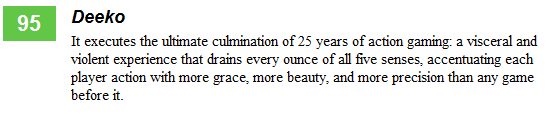
Guess the Game by its Metacritic Excerpt

Us game bloggers talk a lot about games and play a lot of games but rarely make games ourselves. Well here’s one I just thought of. Below are several portions of reviews excerpted by Metacritic. The goal is to correctly identify the game it’s about.

These are all critically and commercially successful games everyone’s familiar with, so if you know enough about games to be reading this blog then none of these should be unknown to you. Also, don’t restrict yourself to using a game only once. Have fun guessing!

Tutorial: Highlight the gray areas to get the name of the game linking to its Metacritic page.