Sins of an Innovative Developer

Sins of a Solar Empire is such a complicated game that I felt compelled to write an accompanying editorial with my review. Because Ironclad has tried something new and fresh, there are more than a few kinks to work through. At least in the current infancy of the game, a big issue Ironclad is tackling is whether a developer caters to the larger gamer audience crowd–even if they’re wrong, or the people playing the game the “right” way.

For various reasons, the game is very difficult to learn to play properly. In no particular order, let me throw a few out there:

1. The single player AI is too easy, to the point you don’t need to utilize counter units, so you don’t learn much about units

2. There’s no campaign to make you learn to use different units in different situations to make up for the general AI being terrible

3. The games are long, but more importantly, it’s long before you see any significant action, raising the time investment to gain skill at the game

4. →  The only thing we have to read is read itself.

What is a game, EGM?

It’s depressing to see prominent video game publications play the role of the conservative establishment. Edge magazine recently doubted that games should strive to be more than simply games. Thank god a modern day equivalent didn’t convince Disney or Groening that cartoons should be no more than children’s entertainment.

On the other side of the Atlantic, Electronic Gaming Monthly has begun reviewing what they call “non-games.” Try as I might, I cannot come up with a satisfactory definition of the word game. EGM must have, though, if they now dedicate a portion of their magazine to video games that are not games. EGM owes the entire community this definition because it may end many squabbles over which consoles are doing well, which games matter, and where the industry is heading.

Before they enlighten the world with a precise definition of game, they need to consider some of the difficulty others have had with the word. Lets start by looking at how the word “game” is defined by Merriam-Webster online:

1 a (1): activity engaged in for diversion or amusement
(2): the equipment for a game
b: often derisive or mocking jesting

2 a: a procedure or strategy for gaining an end
b: an illegal or shady scheme or maneuver

3 a (1): a physical or mental competition conducted according to rules with the participants in direct opposition to each other
(2): a division of a larger contest
(3): the number of points necessary to win
(4): points scored in certain card games (as in all fours) by a player whose cards count up the highest
(5): the manner of playing in a contest
(6): the set of rules governing a game
(7): a particular aspect or phase of play in a game or sport
b plural : organized athletics
c (1): a field of gainful activity
(2): any activity undertaken or regarded as a contest involving rivalry, strategy, or struggle
(3): area of expertise

The first definition looks like the most relevant, only it’s so vague it doesn’t offer much help. →  All this can be yours, if the read is right.

How do you play a non-game?

Language is powerful, which is a shame since I’m not a very good writer. Instead of bringing “war” to Iraq we are bringing “freedom”, and instead of being “the worst American president in the last 300 years”, Bush has “a low approval rating”. Debating the merits of something specific may work for thoughtful people, but it’s much easier to simply change people’s minds by changing how we refer to things.

And so we have non-games. First, I must explain that I am not taking a stance on the quality of any game, non-game or partial-game. It’s a shame that this needs to be said but many people confuse the debate over language as a debate over what the language describes.

“I’m not sure the terrorists hate us because of our freedom.”
“What? You must want the terrorists to win then.”

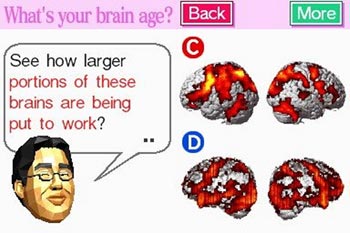
It’s actually a fact that humans don’t use 126% of their brain.

So Brain Training is boring, happy? Even so, the term “non-game” is generally used for anything somewhat different that people dislike. →  All the lonely gamers, where do they all belong?

Fillet Mignon with a side of Pork Rinds: Awesome games and their stupid minigames

The average gamer supposedly plays 7.8 hours a week. That’s an ESA study so I think they rounded down to make gamers seem less crazy. Other studies show more like 20-30 hours a week, which makes more sense to me. For us hardcore gamers, I’m sure the number would be even higher.

So while we waste our life away playing video games, it has become painfully apparent to me that, like most products in our corner cutting capitalist society, video games have a lot of filler. A video game, especially an RPG or MMO, is graded on how much of your time it takes to beat. In most cases, a game with short playtime is over quickly and generally unsatisfying (much like sex with me). Longer games are considered better. One of the first questions people ask about a new RPG is “how long is it?” It’s an important benchmark.

Game developers often choose to provide filler, as opposed to costly and time consuming quality content. →  Apply directly to the forehead.