
Review – Radiant Historia

Radiant Historia gets so, so close to being a bona fide classic. For three quarters of its length, it was my favorite genre-piece since Demon’s Souls. After that, it segued into its (shockingly) boring, generic final act. The biggest surprise of 2011 became the biggest headscratcher.

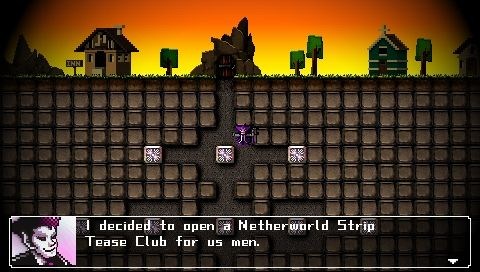
Radiant Historia is a classically styled jRPG with a time travel mechanic at its core. The player guides the protagonist through two different timelines, with the ability to travel to the past or present of either of them at will, maybe to fix a mistake, or to ensure that a certain event occurs. Time travel is at the very core of the game’s design. It drives, and explains, so much of what goes on. For example, while the hero can travel between the timelines, he can’t travel into the future (at least, not any future he has yet to experience). Furthermore, the Time Children who grant him his power are not allowed to feed him information that would alter his decisions. →  What is a post? A miserable little pile of secrets.
Portal 2 Review Part 2/2: The Negative Review

Any motion picture–such as 2001:A Space Odyssey; Demon Seed; Silent Running or Forbidden Planet–or Star Wars–in which the most identifiable, likeable characters are robots, is a film without people. And that is a film that’s shallow, that cannot uplift or enrich in any genuine sense, because it is a film without soul, without a core. It is merely a diversion, a cheap entertainment, a quick fix with sugar-water, intended to distract, divert and keep an audience from coming to grips with itself.” — Harlan Ellison

It is probably safe to say at this point that everyone loves Portal 2. Just look at Metacritic, just look at the sales charts, just look at what anyone, anywhere is saying about it. So what’s even the point of different publications hiring different reviewers anymore? If every single review is glowing and adores the game for all the exact same reasons, then it seems not only natural but efficient to squash them into a giant aggregate number anyway. →  Europa Universalis IV: Articles of War

Portal 2 Review Part 1/2: The Positive Review

The first Portal seemed so undeserving of its success. It was essentially a Half-Life 2 mod similar to Research And Development only with a new gameplay gimmick. The story was only added later in the playtesting phase because players were getting bored with room after room of puzzles. Since the developers didn’t have time to model and animate characters a disembodied voice was created from the same disembodied voice that appears in both Half-Life 2 and Team Fortress 2. The end result was barely marketed at all and distributed merely as a small bonus bundled with other “real” games. By all rights, Portal should have been enjoyed for what it was and forgotten afterwards, along with every other short puzzle game. But it wasn’t. Everyone loved the final product, puzzles, storyline, dialog, and all. Even though it lacked any of the budget, violence, sex, and marketing every other game had it did have some kind of magic that other videogames seem to have forgotten. →  Do the math.

Stalker: Shadow of Chernobyl Non-Review

S.T.A.L.K.E.R.: Shadow of Chernobyl has been a game I’ve declined to review. There are some things I’m just not comfortable casting judgment on. A review implies that the reviewer has authority over the game, an intellectual superiority. I can tell you what I think about Stalker, but Stalker is a complex game full of loose ends; it calls upon a creative power within its players to piece them together. What I think about it is constantly changing the more I play and the more I learn. Any review of the game will say much more about the reviewer than the game itself. This is my non-review. It’s just what I think right now.

I’m going to go ahead and say that I like Stalker–a lot. It’s one of my favorite games ever and I still can’t stop talking about. It has a lot of bad points too, and I don’t believe in homogenous scores so I’m not going to pretend that its good qualities somehow cancel out the many bugs, imbalances, obtuseness, or any other possible complaint everyone has about the game. →  Today I consider myself the luckiest reader on the face of the earth.

Review – AquaNox 2: Revelation

The bottom of the ocean is a lot like space–both are dark and mysterious, both require special equipment in order for us to survive, and both appear as a peaceful shade of blue from our viewpoint. There are, however, some sharp differences between them. No one really goes to space (at least not outside of Earth’s orbit), whereas many people spend lots of their time living underwater. One reason for this is the fact that there isn’t much of anything in space. Every single book, movie, or videogame set in space is forced to make up a bunch of stuff to fill its multi-light-year spanning void. Unless you want to use the Moon as a setting (such as in Moonbase Alpha or the film Moon) then making up a bunch of fantasy stuff is really your only option. Compare this to the ocean, which is full of unearthly landscapes, mysterious wreckages, and more life than we’ve even be able to document.

 →  I only ask one thing. Don’t read in my way.

Review – Afrika

Upon first hearing about Afrika for the PS3, I was intrigued for a few reasons. Natsume (of Harvest Moon fame) was publishing a photography sim set in Africa. Since photography has been touched on in video games but never done to my satisfaction I figured I would give this title a shot. It also helped that Afrika had a very limited run of copies localized for North America and you all know I am a sucker for hard to find games.

There is a lot to like about Afrika. Good graphics, realistic photography (to an extent; more on that in a few minutes), and lots of stuff to take pictures of. I like taking pictures in real life so I figured that my skills and knowledge of photography would translate well into the game. You start off by picking one of two characters and getting sent on assignment to a wildlife preserve in Africa. From there you take various photographic assignments with varying degrees of difficulty and reward. →  WELCOMETOTHENEXTARTICLE

Review – Nier

The first thing you will hear when you start up Nier is swearing. Its intro, as with many other aspects of the game, may be an attempt to be unique. It also foreshadows (or is reminiscent of) a significant plot event. Either way, it’s certainly unusual. Much of the game seems like the intro sequence: it may be an attempt to be unique. It’s harsh and initially somewhat intriguing but each time through it loses a little bit of its charm. In the end, Nier seems to be saying something, but aside from a decent story filled with the requisite twists and turns, it’s impossible to really tell what.

Nier is not entirely a love-it-or-hate-it game, despite all appearances. Most reviewers panned it, saying its quests are too repetitive, its graphics too bland, its gameplay too derivative of the genre(s) it pulls from. I’m inclined to say this is all intentional – all other aspects of the game are incredibly well-done. →  Now you’re reading with power.

Review – What Did I Do to Deserve This, My Lord!?

One of the first games I played on my computer was the Dungeon Keeper series. I was an evil overlord who managed my dungeon with more gusto than a sixteen year old who had been newly promoted to fry manager at McDonald’s. I strove to be as evil as I could and I was good at it. Sometimes I think I missed my dictatorial calling in life. I loved being able to build traps and spawn new monsters to kill whatever hero was foolish enough to traipse into my lair.

Unfortunately, after Dungeon Keeper 2, Bullfrog stopped making the series and my dungeon-building prowess dulled – the lands were freed of my evil grasp. I have always wanted a game to fill the dungeon keeping hole in my heart but alas, the void remained…until recently.

While browsing the selection of download-only PSP titles available on the Playstation Network, I happened upon “What Did I Do to Deserve This, My Lord!?” and after waiting a couple minutes for the download to complete, I was in love. →  This better not be as bad as everything else here.

Review – Ys Seven

Ys Seven is a momentous release for developer Falcom. It is the first Ys game developed natively on the PSP, and it is also the first game in a major licensing deal struck with publisher XSeed Games. Westerners can finally play an original Ys game exactly as it was intended, rather than through a shoddy port.

Anyone excited for their first taste of this cult franchise will be sorely disappointed, however. If you’re looking for an introduction to Ys, you’re better off with Oath in Felghana, or the upcoming Ys 1 & 2 Chronicles. As for Seven, it isn’t an awful game, but even someone as hardly experienced with Ys as I am can tell that it isn’t the best showing the series has to offer.

Ys Seven still uses a realtime combat system, but lacks any need for strategy or precision outside of the boss battles. As long as you keep up your offense and dodge the occasional enemy strike, you’ll never face a truly difficult situation. →  Article Kombat

Review – Ys: The Oath in Felghana

Ys: The Oath in Felghana is a modern remake of Ys 3, one of the more radical entries in Falcom’s long running franchise.  While the first two games were top down adventures in the same vein as Zelda 1, Ys3 is a side scroller similar to Zelda 2.  The promotional website for Oath in Felghana goes into detail as to what the remake entails, stressing that it expands upon the original without heavy alterations or retconning.  I can’t say for certain if it succeeds in this regard, but I can take a guess, because Oath is an excellent game on its own.  It has an old school charm without feeling arcahic, yet it is a careful update that avoids adding the cruft and excesses of modern games.

Oath in Felghana once again stars series heroes Adol and Dogi, who have continued adventuring together after the events of Ys 1 and 2.  Their journeys take them to Dogi’s homeland of Felghana, where bad things are going on.  →  Jet fuel can’t melt videolamer.