Review – Phoenix Wright: Trials and Tribulations

I recently went through some effort to prove that most games are entirely about play mechanics and that story and characters are mere dressing. This concept is echoed by some great designers. In On Game Design, Chris Crawford describes interaction as the key to all games — more, deeper interactions make for a better game. Judging by his designs, Miyamoto agrees.

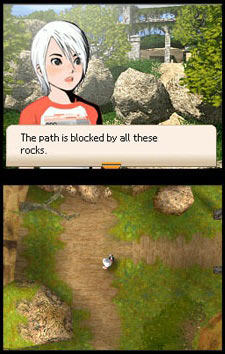
Don’t look at this picture. Too many spoilers.

With this in mind I face a problem. The Phoenix Wright trilogy stands among my favorite games despite their being little more than books on DS carts. And not even Choose Your Own Adventure books that create the illusion of control; there is only one correct thing to do at all points in Ace Attorney, and often you will be forced to run through all items in your inventory in hopes of showing the right someone the right something. Still, the game is compelling and probably would be if there were no interaction at all. →  It’s time to read and chew bubblegum… and I’m all outta gum.

Review – Etrian Odyssey

There is nothing more depressing than wasted potential, and, somewhat ironically, nothing more pleasurable than wasting potential. As I lay on my couch playing Etrian Odyssey instead of washing the dishes, helping the homeless or learning to read, my mind struggled to cope with conflicting emotions. I was enjoying that I was wasting my time, but not enjoying the time wasted. Is it hypocritical to be upset that Atlus squandered this game’s potential?

Etrian Odyssey starts off nice and difficult. I died on the first level and there’s a good chance you will, too. This high difficulty forces the player to engage in some old school level grinding, but I’ve always welcomed work in my time wasting, as long as society doesn’t benefit in any way. Besides being difficult, the first boss required some actual strategy to beat. I tried simply launching every offensive spell and skill at him, entirely ignoring the typically useless status augmentation abilities, only to die before his mighty tendril (note: boss may or may not have actually had a tendril; if he did, it may or may not have actually been mighty). →  I can has post?

Review – Magical Starsign

Gummy frogs! Gummy worms! Pirate Otters! Saving Miss Madeline, our beloved teacher! The Book of the Darned!

The only thing missing from this game is puppy dogs and rainbows, and since I haven’t beaten it yet, I’m assuming there is a puppy dog and rainbow planet. Welcome to Magical Starsign, an RPG for the Nintendo DS made by developer Brownie Brown. Reading Tyson’s recent Heroes of Mana review, he mentioned Brownie Brown is a renegade group that broke off from Square. My guess is that Square rounded up all the people who they thought should be teaching preschool instead of making video games and fired them, but I digress.

The setting for Magical Starsign is the Will o’ Wisp Academy, where a group of students overhear their headmaster talking to their favorite teacher. Apparently one of the Academy’s students, a former dorky kid, has turned into quite the evil badass and is up to no good. I suppose that is the problem with magical academies, instead of getting high paying programming jobs and hiring hookers, the kids who got stuffed in lockers instead turn to gratuitous evil. →  A delayed article is eventually good, a rushed article is all we post.

Review – Heroes of Mana

What do you get when you cross Final Fantasy Tactics with Warcraft? The answer, Heroes of Mana, is about the closest I have come to a perfect game in a long time.

I love my DS; it goes everywhere with me and I play it almost every day. Usually there are very few games on any platform that can get and keep my attention for more than a few hours. I think this is partly because when I play my DS I do so for only half an hour at a time and therefore, it is hard for me to establish a connection to a game that lasts longer than that. It’s like being forced to take a bunch of five minute breaks throughout a two hour movie; you just can’t get into the film. I like games like Warioware, Scrabble, Arcade Hits, etc, because I can play them in small doses and get the full effect out of them. Usually this means I don’t play a lot of long games or RPGs. →  Devil May Read 2

Review – Rune Factory

Game flow usually follows a straightforward path. In any Zelda game, you adventure, find items, speak to an odd character like Tingle, then adventure some more. The adventuring itself is compelling because it is great fun and the items you receive for adventuring often add a new play mechanic and unlock new areas for adventuring — it’s a very simple loop that has worked well for 20 years.

A game like The Sims is significantly more complex but the game flow is still easy to understand. The players micromanage their Sims in order to gain skills and keep their various meters high. In turn, they are rewarded with job promotions because they are skilled, socially relevant, and come to work with full stomachs and empty bladders. With the promotion money, players extend their homes, plant bushes and buy new furniture and electronics. This consumption results in a happier Sim who can make friends more easily, and spends less time bathing, sleeping, and eating – which leads to more free time to learn skills and ultimately more promotions. →  How many games must a gamer play before you call him a gamer?

Review – Trace Memory

I’m not usually a big fan of the point-and-click adventure genre. Myst never managed to keep my attention, despite the rave reviews it got way back when, and the one Kyrandia game I played only managed to entertain because of the constant humor. I haven’t even gotten more than half an hour into The Longest Journey in the two years I’ve had it.

Oh well, looks like the game’s over.

Trace Memory, though, managed to keep me engaged through to the end. Even when Puzzle Quest failed to interest me, I continued to play Trace Memory. It could be that the medium keeps the idea of the game interesting. This was my only DS with a particularly compelling or deep story I hadn’t beaten, and I think that was a big part of what kept me motivated. I enjoy playing story-heavy games, and they aren’t very common on portable systems, so I try to play as many as I can get my hands on. →  Europa Universalis IV: Articles of War

Review – Hotel Dusk

Before I jump into this review, I would like to offer some insights into my reviewing habits. When I play games to review them, I try to see if the development team was successful in whatever they were trying to do with the game. For example: have they made an exciting action/adventure game or a plausible horror game? I basically become a high school English teacher and grade a student’s essay. Did they prove their point with supporting examples? It does not matter if I disagree with what they are saying. Unless they screw up with their grammar or examples, can I blatantly say they are wrong?

Why am I telling you this, you ask? I’m just trying to give you a little background info on how I’m going to review Hotel Dusk: Room 215, for the DS. This game may not be for everyone, but that’s the point. Cing had one goal in mind, and approached it without fear of what the players would say. →  Ask not for whom the game plays, it plays for thee.

Review – Contact

A game is like a meal. An excellent one both pleases your palette and assuages your hunger. Resident Evil 4 was a full plate of filet mignon. Extremely filling, but not excessive, and delectable (this is getting creepy). A Nippon Ichi game is more like three plates of macaroni and cheese. Decent, but if you eat it all you’ll feel sick. And then there are games that are so bad you look forward to them ending. Eating less vomit or dog shit is preferable.

Enough of something decent can make an average game more satisfying than it should be. Dragon Quest Rocket Slime is by no means gourmet, but there is enough of it to really fill the player. The play mechanics aren’t spectacular, but the game is long enough to both build and expand on them. It achieves the rank of full plate of steamed vegetables.

Contact is barely palatable and, even worse, is at most an appetizer. This is a letdown because its packaging (complete with blog entries in the manual) and buzz – which drools over the music for no apparent reason – make it sound like an exotic dish most of us have never tasted. →  A delayed article is eventually good, a rushed article is all we post.

Trace Memory: Worth the Effort

After reading some of the reviews for Cing’s DS adventure game, I was a little hesitant about picking it up. I love adventure games, but the puzzles were cited as being a pain in the ass. So, I did the next best thing. I put it on my GameFly Game Q.

Having finished it, I’ve to come to the realization that reviewers have no idea what makes a game good. This was a great adventure game, and I easily recommend trying it. It is very short (it only took me 5 hours to beat), but for the low price of $15 at GameStop, you make out on the deal.

I won’t divulge any of the story, only because that’s the main reason for playing adventure games, and I won’t be the bad guy and spoil it for you. Just know the story and localization are very good, and you’ll enjoy it while it lasts.

Also, Cing uses the DS in ways I’ve never seen before. →  Welcome to read.

Review – Harvest Moon DS

Seriously, did you ever think a farming simulator would be a fun game to play? Of course it would be, how silly of me. Finally appearing on the DS, Harvest Moon DS brings the enjoyable horticulturalist gameplay to the dual-screened handheld, but not without its fair share of problems.

In Harvest Moon, you play as a young man in charge of his family’s farm. In all previous HM games, there has not been any back-story, so don’t be surprised that you don’t find one here, either. Just know it’s up to you to restore your family’s farm to its once graceful status.

Cat…hand stroking it…nope, I can’t think of anything clever to say about this picture.

The only thing that could be remotely called a storyline in HM is the argument between the Harvest Goddess and the Witch. The Witch is fed up with the Goddess for some reason and puts a spell on her, but it turned out to be the wrong spell. →  The fuck does Cuno care about reading?