Ads from Loser Companies

The early days of EGM (Electrical Gamers Magazine) were resplendent with ads from companies of ill repute, often advertising games that are remembered poorly if they are remembered at all. Perhaps ad buys were a few dollars because the magazine had just gotten started and had a readerbase as low as videolamer at its 2008 peak, or perhaps these companies were somehow flush from the bubble days of Famicom games selling well regardless of quality. I refuse to believe it could be both, so please do not consider it.

Our first ad is from a company called SETA. No, not SEGA, SERA. I mean SETA. This (SETA) Corporation developed the hits you know and love, like Magic Darts for NES and Strongest Habu Shogi on the GameCube. They did publish one or two interesting games, such as the following ad’s Musya. If any readers joined the SETA Club, please send me your pin.

American Softworks is up next, the publisher who brought us Sküljagger: Revolt of the Westicans, Power Punch II, and Treasure Master. →  The post still burns.

EGM Previews for Bad Games

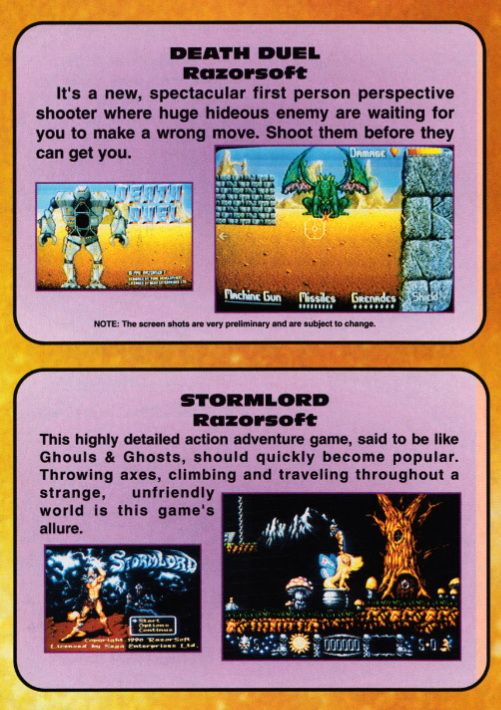
In a recent post, I mentioned that EGM spent a good deal of time talking up obviously shitty games. Here is a short, mostly visual, follow up to that thesis. At least this first game made a great movie… to ridicule. But please don’t do that, I’ve copyrighted both ironic enjoyment and hipster condescension.

What a sweet follow up ad to the Hudson Hawk preview. The next preview is for a game I actually owned and played a lot of. It was bad but I was young so it was good. Street Smart had some mild RPG mechanics – if I recall, you gained a stat point or two after winning fights. Numbers (or, in this case, boxes) going up was and is human-nip for me.

Here is another Genesis game I played as a childish child. It is also bad but has a weirdness about it that is offputting and cool. I can’t think of many other games that let you turn into a centaur or merman, though I have always wanted to play the PS1’s Meremanoid. →  The fuck does Cuno care about reading?

Politics, previews, and poppycock

Video game previews have always seemed primarily a marketing tool. I remember complaining about IGN previews in the aughts when the site, clearly a detached arm of publishers, would post sometimes a dozen preview articles on a big upcoming game. (Correction, I complained about a bunch of sites.)

Old issues of Electronic Gaming Monthly had previews of games that range in tone from neutral to PR. The previews that read like marketing are interesting when contrasted with the constant bloviating the magazine did about being the only true, tell it like it is, in your face, no holds barred, Carlos-Mencia-style magazine on the market. If you’re over the age of 15 AND are not a fucking moron, you know that when people tell your their traits directly, they’re lying. The more EGM claimed to be objective, the more apparent their rave reviews of Bubsy were paid for. I know this because I am both smart and funny.

Come with me on a political tangent with no jokes and also opinions you don’t agree with that applies grandiose theories to video game magazines. →  Xenoblade Articles X

Wasting time reading old magazines

The Video Game History Foundation’s online archive of old magazines is now my favorite thing. Instead of spending all day at work refreshing a message board to see if any newly announced games remind me of old games, I just look at coverage of old games. Sure, the site fails to load the magazine you tried to view about 75% of the time If you get to it by searching for a specific game, but I’m not busy. And if you just progress by issues through a specific magazine, the site is mildly usable.

There are other magazine preservation websites and even archive.org keeps some in their archivedotorg. But that goes to show the power of PR. Not good PR because Frank Cifaldi comes across as someone who dislikes old games and people who like old games, but PR nonetheless. The guilt of having ignored these other sources and only jumping into old magazine scans because the Video Game History Foundation led me to check out issues of Sega Visions in the previously mentioned archive. →  And so it games…