Murdering children does not grant you magical powers – More thoughts on good and evil in games

I started to write this as a postview of one of my favorite games, Beyond Good & Evil, when it occurred to me that there has been a lot of talk over here at videolamer recently about, well, good & evil. Shota seems annoyed both that so many games are overwhelmed by universe destroying, Pure Eeeevil, and also about the preponderance of good characters that restore our faith in the good ol’ dependable U.S. of A. and its various institutions. I largely agree with his frustrations, but this post is an attempt to complain and moan about the recent spate of games that ham-handedly try to explore good & evil within the plot and structure of the game: such as KOTOR, Fable, and Bioshock. Also, I’m going to propose a better way of doing it.

Most of the games mentioned above (I’m not sure about Baldur’s Gate since I unfortunately never finished it) take a pretty cut-and-dry approach to good and evil. →  You lost me.

Beyond Good and Evil – Slightly less than amazing

Beyond Good and Evil is the poster child for several “Most Underrated Games of All Time” lists. It has a small army of dedicated fans who will just about yell and scream at the unwashed masses who haven’t played it yet. To even consider it as a bad game is an act of treason to every website and hardcore gamer on the ‘net.

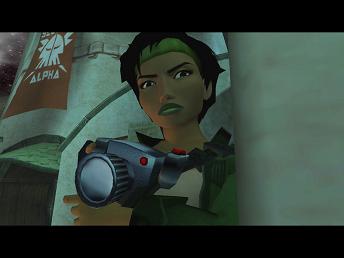
See if you can follow this: She wears green lipstick, a green headband, green jacket, off green pants, and her name is Jade.

Folks, get the noose ready, because I’m about to go for broke. While I have to blame some of it on the hype that was slathered on it for months on end, Beyond Good and Evil is nevertheless one of the most underwhelming gaming experiences I have ever had. I’ve heard all the arguments for it, and even the best have been unable to convince me of this game’s quality. I just can’t see it, though lord knows I’ve tried. →  Read or Alive 2: Hardcore