

The original Mount & Blade was the very first game I wrote about on videolamer. I was really impressed by the sandbox approach it used. The world advances, in real time, as you move from place to place (in a kind of real-time-with-pause simulation style). This has been done before, for example in Uncharted Waters or the excellent Space Rangers series. Mount & Blade adds excellent combat mechanics that incentivized (but didn’t require) a shield and allowed for seamless, interesting mounted combat. It also brings in a character growth system that extends to companions in your party. While other games might see you becoming a “superman” in a few hours, in Mount & Blade you max out at “mighty” – and will always be vulnerable to an enemy’s morningstar or crossbow.
As revisions came in for the original games, new factions and weaponry were added and eventually Mount & Blade: Warband came out. Warband could be considered Mount & Blade II but was more of an expansion, adding more complex politics and a couple of new factions as well as multiplayer. Importantly, though, there was enough of a fanbase and the system was extensible enough that mods were plentiful. Although my favorite was The Last Days, the Lord Of The Rings mod that still receives updates, there were several fantastic total conversions as well as a lot of smaller mods that extended the “Vanilla” experience.
The “actual” Mount & Blade II, subtitled Bannerlord, isn’t a bad game per se, but it misses the mark on what made Warband so addictive. It focuses more on set pieces than sandbox features. While these are interesting the first time, by the fifth invasion of a bandit hideout it is no longer as fun. Diplomacy is somewhat middling, the campaign quest seems tacked on, and while the family and aging system has potential it isn’t particularly exciting due to its extremely slow pace. It may have been more interesting if the “Realistic” death settings were realistic in the least, because there is a clan/inheritance system that feels underutilized. Worst of all, mods seem relegated to “Adds [Storm Troopers/House Baratheon/Sauron/Rome] as a minor faction”, rather than more transformative or mechanically interesting changes.
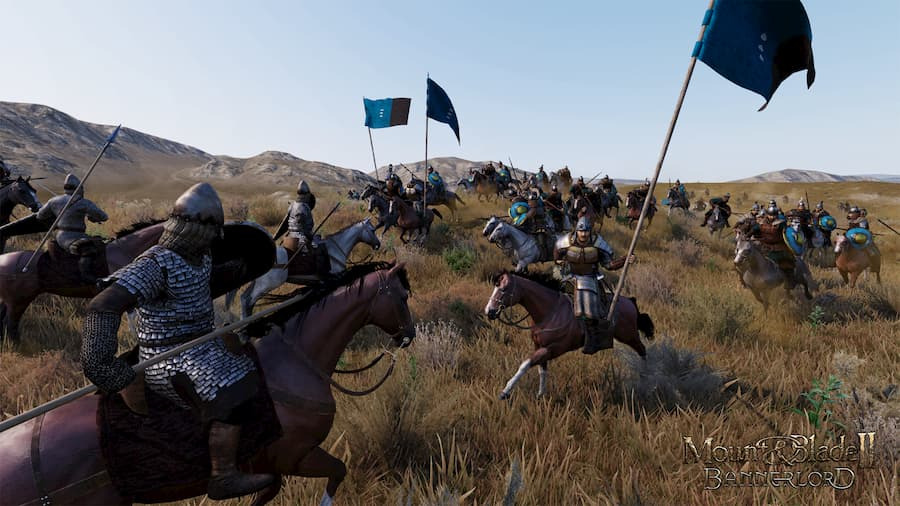
To be 100% clear – I played and enjoyed 30+ hours of Bannerlord, entirely in a singleplayer campaign. It’s a serviceable game but it seems to be more of a trade-off mechanically from Warband. While there are some features that are entirely new and interesting – persuasion, clans, and blacksmithing – these all feel somewhat halfhearted in different ways.
Persuasion seems to be connected to a reputation system, but I couldn’t find a way to augment a reputation. For example, you can be known as merciful, but I only ever had (or saw) one “rank” of merciful, no matter how many lords I let go or villages I spared from taxes. It also seems totally disconnected from either the Charm or Trade stats. After the first few rounds of persuasion, I found it more frustrating than interesting or challenging, especially since the chances of persuasion working don’t actually vary that much from character to character.
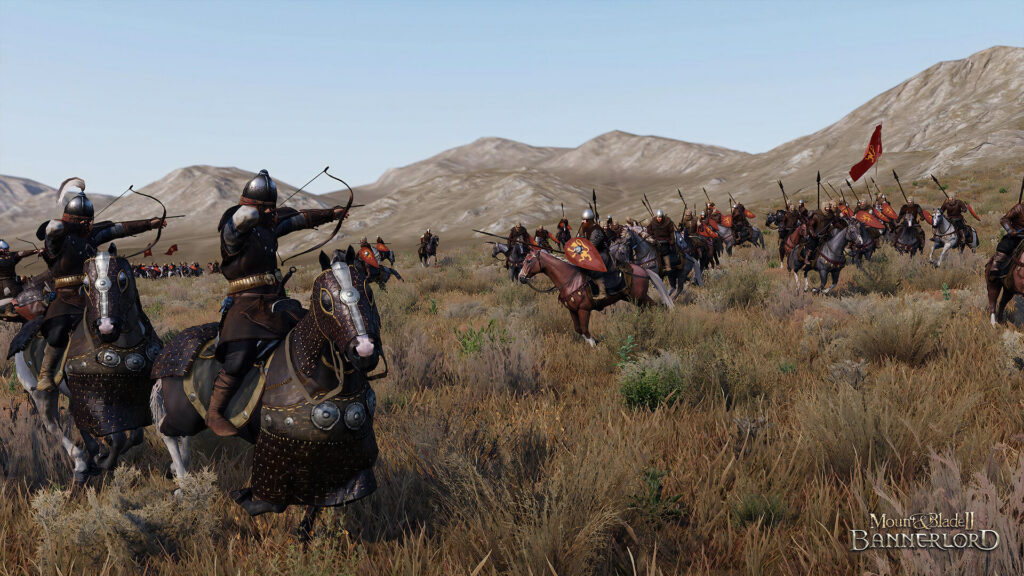
Clans, likewise, seem like an interesting idea, but the implementation is somewhat lacking. Effectively they act as sub-kingdoms – for example, you can order family members or companions to form their own party and set their general policy (defense/offense, and party cost limits). While this is a powerful option, especially for a budding kingdom, there’s not much control over where they operate, which can be frustrating.
Blacksmithing is probably the most fun of these new systems, because it offers both a source of money and a way to kit out your companions. But since it is limited to weapons – and only a subset of weapons (mostly melee) – it feels like a pretty tedious system for relatively marginal benefits. If it expanded to armor, or offered benefits for crafting crossbows, that would have had the dual purpose of giving blacksmiths more motivation and giving crossbows more long-term viability against bows. Crafting a fantastic two-handed sword and then using it in battle does feel rewarding, but there is little reason to use most of the many unlockable smithing components. I’m not sure what the overlap is between someone who will care deeply about their pommel and someone who will spend 40 hours playing a simulation-action game.
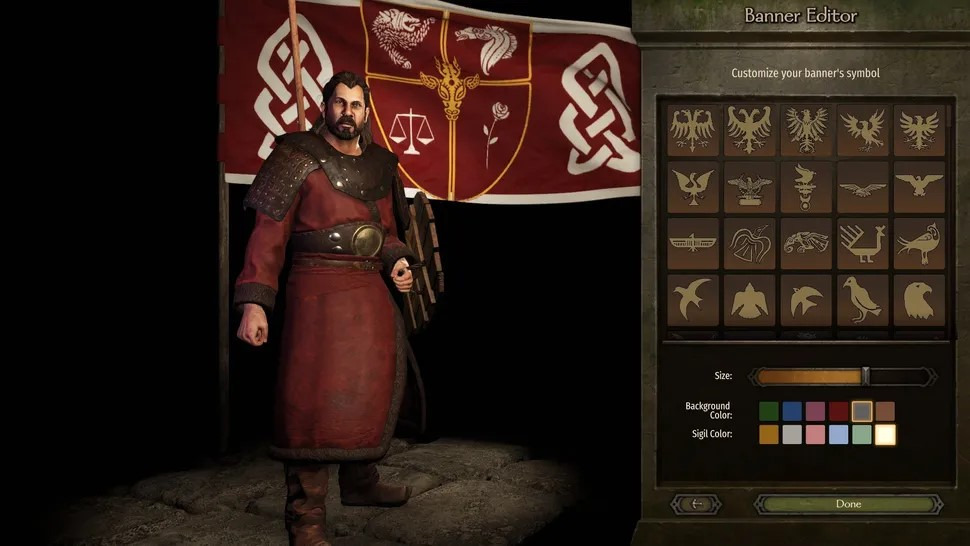
While I do appreciate the larger variety of base weaponry available to the player, it seems most biased towards melee combat (similar to blacksmithing). While rarer variants of some ranged weapons exist, the most powerful ones either do not have variants or their rarity is even higher – so for a player who wishes to focus on ranged combat, they will hit their growth ceiling much earlier than a melee-focused player.
Fief management seems like it has been improved from Warband in some ways but gotten worse in others. In Warband you could be given individual villages, which was a reasonable starting point for a starting lord. Bannerlord divides fiefs into towns and castles (each of which has some attached villages, serving as vulnerable points you must defend). While you can build improvements to your castles/towns, they seem mostly to be lackluster passive upgrades that offer weekly income or recruitment benefits. Loyalty of towns/castles is extremely hard to manage, particularly when serving another kingdom – the main loyalty modifier that is controllable is “culture” meaning you should appoint a character matching the culture to the town, but unless you have intentionally recruited companions of various cultures – and are willing to let them sit gathering dust managing the town – you’re more likely just not to engage with the system at all.
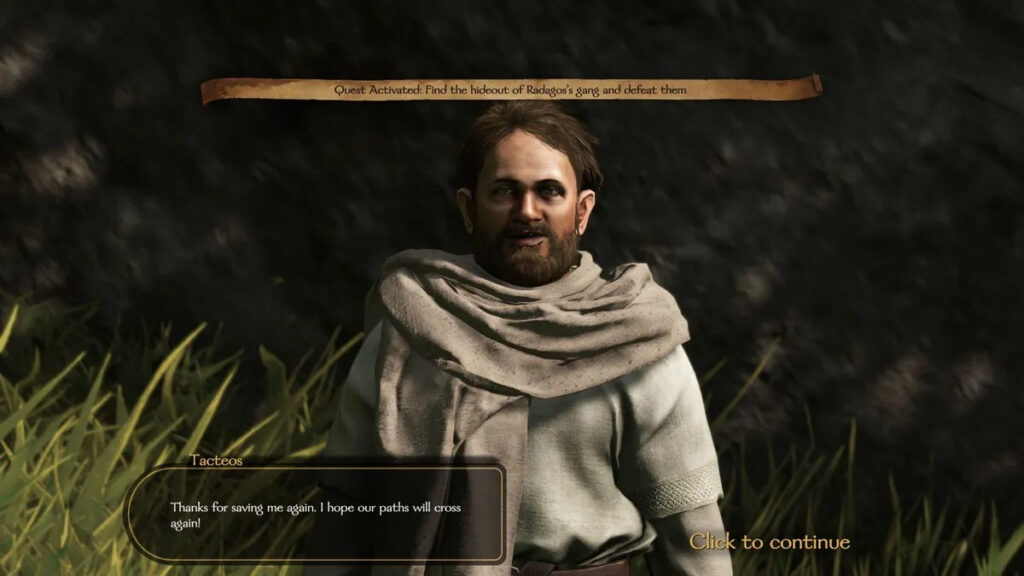
Character growth is better than Warband, but there are downsides as well. Skill levels have been expanded (beyond Warband’s weapon skills), and each has a guiding attribute. You can allocate focus points (more frequent) towards specific skills, letting you grow in that skill faster and raising the ceiling you can reach. At certain breakpoints, you unlock one of two perks for that skill – for example, faster walk speed while using a bow or stronger headshots – and pick one. Some of the time this feels good: picking between one of two powerful options is fun. More of the time, it’s unclear what the actual gameplay impact will be (“Adds 5% swing speed when wielding a scythe on Tuesdays”), or the pick is so obvious for your character that no thought is required. Stat points (less frequent) have a similar effect to Focus Points for all three corresponding skills (for example, a Control stat affects bows, crossbows, and thrown weapons). These mostly come into play once you have already maxed out Focus points on a given skill.
While I’m fairly lukewarm on the game overall, I will say that castle battles in particular are much more interesting in Bannerlord than in Warband. Catapults and ballistae are both a lot of fun to use (although Trebuchets are too finicky to be particularly useful) – and one of the joys of defending is getting throwable rocks to use strategically to protect certain chokepoints such as inner doors or ladder-scalable walls. In a pinch, you can even borrow some catapult ammunition for the same purpose.
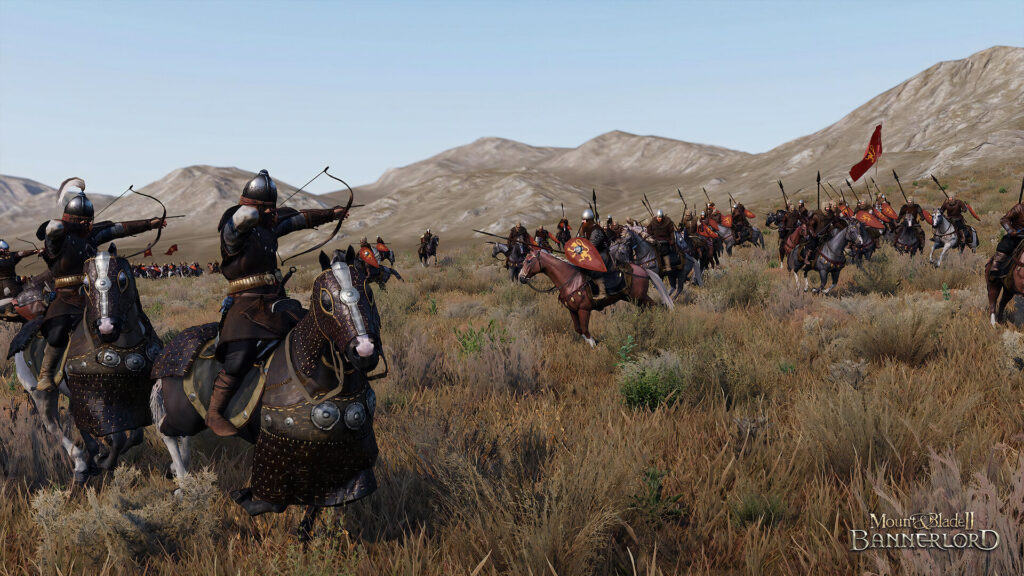
While I’m not sure I would recommend Bannerlord to a Warband player, it’s overall a pretty nice sandbox package. It is a better entry point for the style of game than Warband was, as it offers a better tutorial and has a more modern UI. Unfortunately, it’s likely to not be as engaging in the long term due to the relatively small modding community, which really elevated Warband over similar games for me.
[…] While I considered the more cohesive, better-balanced Warband, for this particular scenario I think Bannerlord wins out with more styles of play, multi-generational characters, and overall polish. […]